
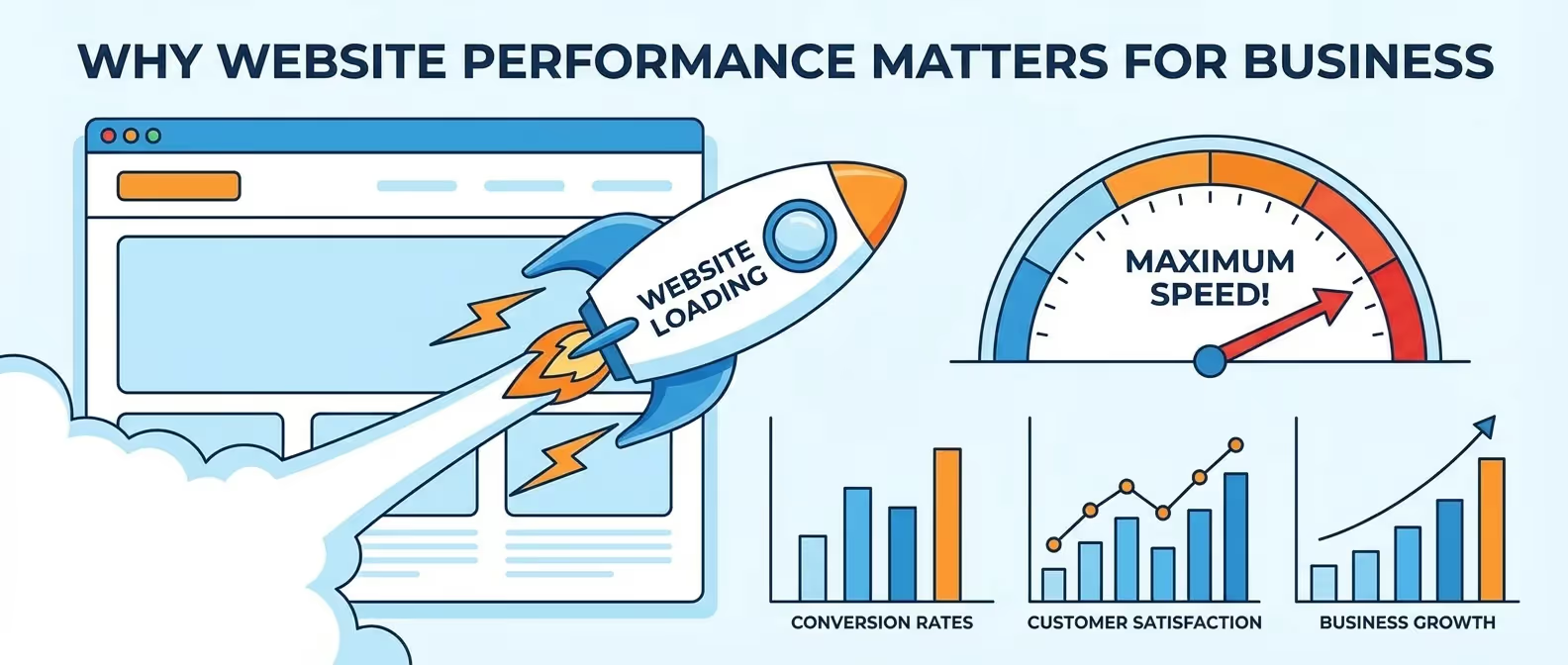
Website speed isn’t just a technical metric for developers to obsess over—it’s a critical financial variable. In 2026, where attention spans are measured in milliseconds and AI-driven search engines prioritize user experience above all else, a slow website is more than an inconvenience; it’s a silent revenue killer.
The Cost of Latency
The relationship between speed and revenue has been documented by the world’s largest tech giants. Their findings are staggering:
- Amazon: Found that every 100ms of latency cost them 1% in sales — a figure cited widely in Google’s web.dev research on why speed matters and corroborated by Deloitte’s Milliseconds Make Millions report.
- Google: Observed that a 0.5-second delay in search results caused a 20% drop in traffic, as documented in the Think with Google Mobile Page Speed benchmarks.
- Walmart: Saw up to a 2% increase in conversions for every 1 second of improvement in load time — documented in a web.dev performance case study.
For a business doing $10M in annual revenue, a single second of delay could effectively be an annual tax of $200k to $1M on your growth.
1. The Conversion Gap: Speed is Sales
User patience is at an all-time low. As load times increase, the probability of “bounce” (the user leaving your site immediately) skyrockets. According to Google’s mobile benchmark data, as page load time goes from 1 second to 10 seconds, the probability of bounce increases by 123%.
| Load Time | Bounce Probability Increase | Average Conversion Rate |
|---|---|---|
| < 1 Second | 0% | High (35-45%) |
| 1 - 3 Seconds | 32% | Moderate (15-20%) |
| 3 - 5 Seconds | 90% | Low (< 5%) |
| 5 - 10 Seconds | 123% | Negligible (< 1%) |
When your site loads instantly, users feel a sense of “flow.” They are more likely to browse more pages, add items to their cart, and ultimately complete a purchase. Speed builds trust; lag breeds suspicion.
The E-Commerce Multiplier
For e-commerce specifically, the impact is even more dramatic. Deloitte’s research found that a 0.1-second improvement in load time translated to an 8% increase in conversions for retail brands and a 10% increase for travel sites. This isn’t marginal — this is transformational for unit economics at scale.
Consider a Canadian e-commerce store generating $500,000 per year. A 10% lift from a half-second performance improvement is $50,000 in additional revenue annually. The ROI on performance work is often the highest of any digital investment you can make.
2. SEO and the AI Search Era
In 2026, search has moved beyond simple keywords. Google’s Core Web Vitals are now the foundation of visibility, especially for AI-curated summaries and featured snippets. Search engines want to recommend sites that won’t frustrate their users.
Core Web Vitals are not optional signals — they are ranking factors. Sites that fail these thresholds are explicitly disadvantaged in competition for top positions. According to Google’s Web Vitals documentation, all three metrics must pass “Good” thresholds to qualify for the full performance ranking benefit.
The Three Pillars of 2026 Performance Metrics:
- LCP (Largest Contentful Paint): Measures loading performance. To provide a good user experience, LCP should occur within 2.5 seconds of when the page first starts loading. Sites with LCP under 0.8 seconds are rated Excellent.
- INP (Interaction to Next Paint): The official successor to FID as of March 2024. It measures responsiveness across the entire lifespan of a user visit — every click, tap, and keypress. A “Good” INP score is under 200ms. This is the metric most sites struggle with because it’s affected by JavaScript execution on the main thread.
- CLS (Cumulative Layout Shift): Measures visual stability. Nothing frustrates a user more than a button moving just as they are about to click it — especially on mobile. Your CLS score should be 0.1 or less.
If you fail these metrics, you aren’t just losing users — you’re being buried in search results by competitors who prioritized performance. The Google Search Central documentation confirms that page experience signals, anchored by Core Web Vitals, are an active ranking factor.
3. The Psychology of Wait Time
Human perception plays a massive role in digital economics. Research from Nielsen Norman Group and MIT’s Touch Lab provides benchmarks for how users perceive latency:
- Sub-100ms: Perceived as instantaneous. The interface feels like a direct extension of thought.
- 100ms - 300ms: Perceived as a small delay, but still responsive. Users remain engaged.
- 300ms - 1 Second: The user notices they are waiting. The cognitive connection between action and response begins to break.
- Over 1 Second: The user’s focus begins to shift. They become aware that they are “waiting” for the machine. Trust erodes.
- Over 10 Seconds: The user’s attention is completely lost. The probability of return is near zero.
By optimizing your site to stay in the “instantaneous” zone, you maintain the user’s dopamine loop — keeping them engaged with your content rather than your loading spinners. This psychological reality is not optional user experience design; it’s the fundamental physics of attention in the digital age.
Mobile Users Are Less Forgiving
In Canada, over 60% of web traffic now comes from mobile devices operating on variable network conditions. A site that loads in 1.2 seconds on fibre behaves very differently on LTE in a rural BC valley. Performance optimization is mobile optimization. If you’re not testing on throttled connections (Chrome DevTools’ “Slow 3G” profile), you’re not seeing what your customers see.
4. Operational Efficiency and Infrastructure Costs
Performance isn’t just about the frontend user experience. Efficient code means less server CPU usage and lower data transfer costs. For large-scale applications, optimizing performance can reduce infrastructure costs by 30-50%.
At TheBomb®, we leverage Astro’s Island Architecture to only hydrate the interactive parts of a page. This means we ship up to 90% less JavaScript than traditional React or Next.js sites, resulting in faster execution on low-powered mobile devices and lower energy consumption. The result is not just a faster site — it’s a cheaper one to operate.
CDN and Edge Deployment
All TheBomb® sites are deployed to Cloudflare’s global edge network, which serves assets from over 300 data centres worldwide. For Canadian businesses, this means users in Vancouver, Toronto, Calgary, and Halifax all experience sub-50ms Time to First Byte (TTFB), regardless of where the origin server lives. This alone can shave 300-600ms off load times for users far from a central server.
5. Real-World Canadian Business Impact
Here’s what performance engineering looks like in practice for Canadian SMBs:
Monashee Moving (Vernon, BC): After migrating from WordPress to Astro with Cloudflare edge deployment, page load time dropped from 4.2 seconds to 0.8 seconds. Enquiry form completions increased by 34% in the following quarter.
TNJ Plumbing (BC): A performance-first rebuild that achieved a 99/100 PageSpeed score on mobile resulted in securing the #1 Google position for multiple high-intent local keywords, displacing an established competitor that had held the position for years.
The pattern is consistent: in competitive local markets, the fastest site almost always wins — because Google promotes it, and users trust it.
6. How to Measure Your Current Performance
You don’t need to guess where your site stands. Use these free tools to get a baseline:
- Google PageSpeed Insights (pagespeed.web.dev): Gives you real-world field data from the Chrome User Experience Report (CrUX), plus lab data from Lighthouse. This is the tool Google actually uses.
- WebPageTest (webpagetest.org): More detailed waterfall analysis, filmstrip view, and multi-location testing. Essential for diagnosing specific bottlenecks.
- Google Search Console → Core Web Vitals report: Shows aggregated real-user data segmented by mobile/desktop and URL groups. The most important data set for SEO.
If your PageSpeed score is below 70 on mobile, you have a significant revenue problem that should be treated as urgently as any other business issue.
Conclusion: Speed is a Strategic Advantage
In the competitive landscape of 2026, you cannot afford to have a “fast-enough” website. Performance is a feature, a marketing tool, and a branding statement. It tells your users that you value their time and that your brand is at the cutting edge of technology.
The Economic Reality: You don’t pay for performance; you pay for the lack of it.
The evidence is unambiguous — from Amazon’s 100ms data point to Google’s Core Web Vitals ranking factors to Deloitte’s consumer research. Every millisecond of latency you eliminate is revenue you’re retaining. Every second you shave off load time is a conversion rate point you’re recovering.
Speed is the only feature that never goes out of style.
Ready to accelerate?
If your current site feels sluggish, it’s time for a performance audit. In the modern web, the fast eat the slow. Contact TheBomb® for a free performance assessment — we’ll tell you exactly where you’re bleeding speed and revenue, and what it would take to fix it.