

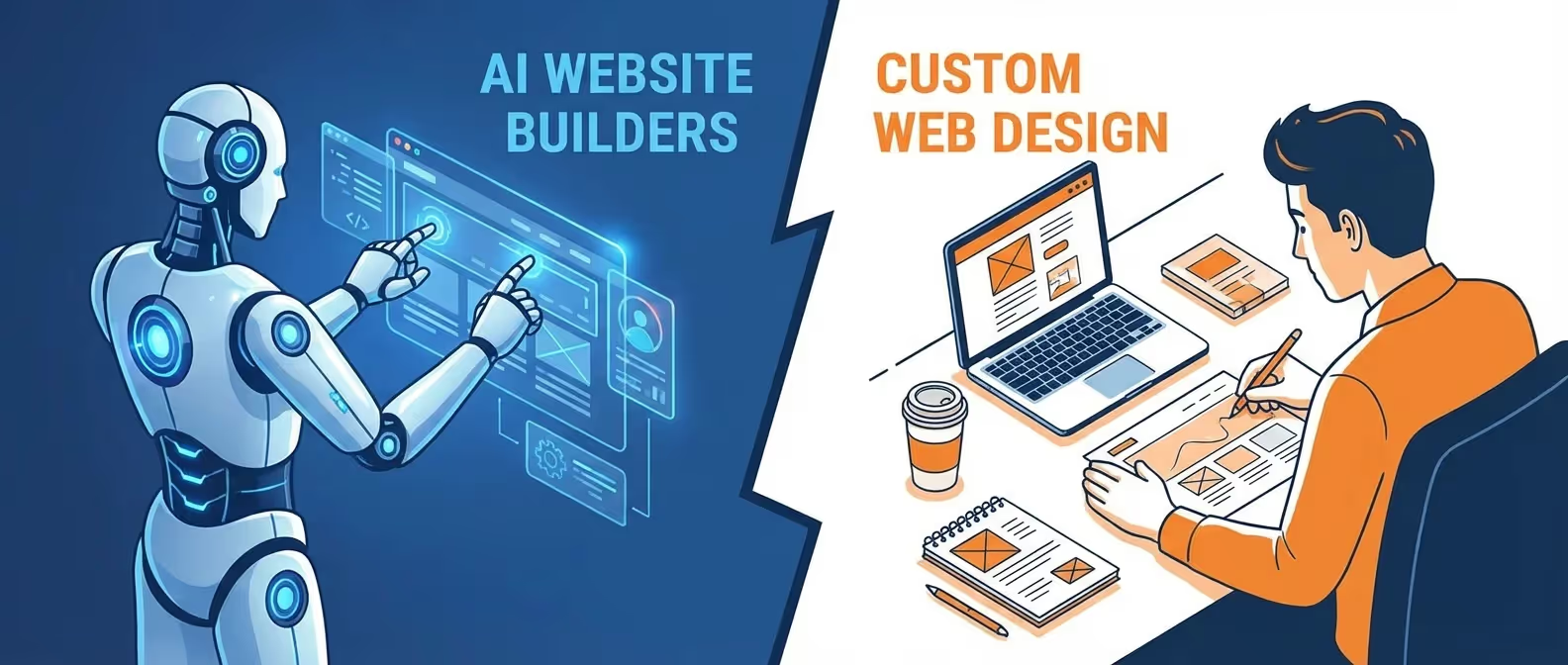
If you’ve been anywhere near the internet in the last year, you’ve seen the ads: “Build a stunning website in 60 seconds with AI!” Platforms like Wix ADI, Squarespace AI, Hostinger AI Builder, and even WordPress with its Jepa AI assistant are promising that anyone can create a professional website without touching a single line of code.
And honestly? For some businesses, that’s a perfectly valid option.
But for others, an AI-generated website is the digital equivalent of a prefab shed when what you actually need is a custom-built storefront. The trick is knowing which camp your business falls into.
At TheBomb®, we build high-performance custom websites for Canadian businesses every day. But we’re not here to trash AI builders—we’re here to help you make a smart decision. Let’s break it all down.
The Rise of AI Website Builders
AI-powered site builders have evolved dramatically since the early days of drag-and-drop editors. Here’s where the major players stand in 2026:
- Wix ADI now generates full multi-page sites from a single business description, complete with stock imagery, copy, and basic SEO settings.
- Squarespace AI uses generative design to create layouts that adapt to your brand colours and content.
- Hostinger AI Builder offers one of the cheapest entry points, generating a complete site for under $3/month.
- HubSpot’s CMS Hub integrates AI content generation directly into its marketing-focused platform.
- Durable, 10Web, and Framer AI round out a crowded field of newer entrants competing on speed and simplicity.
According to Statista, the global website builder market is projected to surpass $3.5 billion USD by 2027. It’s clear this isn’t a fad—AI builders are here to stay.
What AI Builders Are Genuinely Great At
Let’s give credit where it’s due. AI website builders solve real problems for real people:
Speed to Launch
Need a site live by Friday? An AI builder can get you from zero to published in under an hour. For time-sensitive situations—a pop-up event, a seasonal promotion, a quick landing page—that speed is genuinely valuable.
Low Upfront Cost
Most AI builder plans range from $0 to $40 CAD/month. If you’re a solo freelancer, a weekend market vendor, or a student launching a side project, spending $5,000+ on a custom site doesn’t make financial sense yet.
Simplicity
You don’t need to understand DNS, hosting, deployment pipelines, or responsive breakpoints. The platform handles all of it. For non-technical business owners, this removes a massive barrier to getting online.
Good Enough for Simple Use Cases
If your website is essentially a digital business card—your hours, location, a few photos, and a contact form—an AI builder will produce something perfectly serviceable. Not every business needs a complex web presence.
Where AI Builders Fall Short
Here’s where things get more nuanced. The limitations of AI builders aren’t always obvious until you’ve been using one for six months and hit a wall.
Performance and Core Web Vitals
AI builders inject significant overhead: bloated JavaScript bundles, render-blocking CSS, third-party tracking scripts, and unoptimized images. In our testing, the average Wix site scores between 55–75 on Google PageSpeed Insights for mobile, while a well-built custom site routinely hits 95–100.
Why does this matter? Google has confirmed that Core Web Vitals are a ranking signal. Slower sites rank lower, and they lose visitors—53% of mobile users abandon a site that takes longer than 3 seconds to load, according to Google’s own research.
SEO Control
AI builders give you basic SEO: title tags, meta descriptions, and alt text. But they typically lock you out of:
- Custom schema markup (critical for rich snippets and local business visibility)
- Granular URL structures (you’re stuck with whatever path convention the platform dictates)
- Server-side rendering control (important for how search engines crawl your content)
- Advanced redirect management (try migrating away from Wix sometime—it’s painful)
- Core Web Vitals optimization at the code level
If SEO is a serious growth channel for your business, these limitations compound over time.
Customisation Ceiling
Every AI builder has a ceiling. You’ll eventually want something the platform doesn’t support—a custom booking flow, a unique interactive element, a specific third-party integration, or a layout that breaks the template grid. At that point, you’re either compromising your vision or starting over.
Platform Lock-In
This is the one most people don’t think about until it’s too late. Your Wix site lives on Wix. Your Squarespace site lives on Squarespace. If you decide to move, you’re essentially rebuilding from scratch. Your URLs change, your SEO equity is at risk, and your content needs to be manually migrated.
With a custom site, you own everything—the code, the hosting relationship, the domain configuration, and every piece of content.
Cookie-Cutter Branding
AI builders pull from template libraries. No matter how clever the algorithm, your site will share DNA with thousands of others. For businesses where brand differentiation matters—law firms, creative agencies, luxury hospitality, health clinics—this is a real problem.
When Custom Web Design Makes Sense
Custom web design isn’t just about aesthetics. It’s about building a digital asset that works as hard as you do. Here’s when the investment pays for itself:
Brand Differentiation Is Critical
If your competitors are all using Squarespace templates (and in many Canadian industries, they are), a custom site immediately sets you apart. First impressions happen in about 50 milliseconds, and a unique, polished design builds trust faster than any template can.
You Need Complex Functionality
E-commerce with custom product configurators. Client portals with authentication. Multi-step booking systems. API integrations with your existing business tools. These aren’t edge cases—they’re standard requirements for growing businesses, and they’re exactly where AI builders break down.
SEO Is a Primary Growth Channel
If you’re investing in content marketing, local SEO, or competing for high-value search terms, you need full control over your site’s technical foundation. Custom development lets you implement proper schema markup, optimize crawl efficiency, control rendering behaviour, and build the kind of fast, accessible site that Google rewards.
You’re Planning for Scale
A custom site built on a modern framework like Astro or Next.js can scale from a 5-page brochure to a 500-page content hub without performance degradation. Try that on an AI builder and you’ll be fighting the platform every step of the way.
The Real Cost Comparison
This is where most “AI vs. custom” articles get it wrong. They compare the sticker price of an AI builder ($20/month) to the upfront cost of a custom site ($5,000–$15,000+) and declare AI the winner. But total cost of ownership tells a different story.
AI Builder: True 3-Year Cost
| Item | Cost |
|---|---|
| Platform subscription (Business plan) | $40/month × 36 = $1,440 |
| Premium plugins/apps | ~$15/month × 36 = $540 |
| Stock photography | $200–$500 |
| SEO plugin or tool | ~$10/month × 36 = $360 |
| Your time (learning, building, maintaining) | 80–120 hours × your hourly rate |
| Estimated 3-year total | $2,500–$4,000+ (plus your time) |
Custom Site: True 3-Year Cost
| Item | Cost |
|---|---|
| Design and development (one-time) | $5,000–$15,000 |
| Hosting (Cloudflare, Vercel, etc.) | $0–$20/month × 36 = $0–$720 |
| Domain renewal | ~$15/year × 3 = $45 |
| Maintenance/updates (optional retainer) | $500–$2,000/year |
| Estimated 3-year total | $6,500–$22,000 |
Yes, custom costs more. But here’s what you get for that investment: a site that loads faster (which means more conversions), ranks better (which means more organic traffic), and doesn’t charge you a monthly toll to access your own business presence. Over five years, the gap narrows significantly—and the performance advantage compounds.
For businesses generating $200K+ in annual revenue, a custom site that improves conversion rates by even 1–2% pays for itself within months.
A Practical Decision Framework
Not sure which path is right for you? Run through these questions:
Choose an AI builder if:
- Your annual revenue is under $100K and marketing budget is tight
- You need a simple informational site (under 10 pages)
- You don’t depend on organic search for lead generation
- You need to launch in days, not weeks
- You’re comfortable with “good enough” design and performance
Choose custom web design if:
- Your website is a primary revenue driver or lead generation tool
- You operate in a competitive local market where SEO matters
- You need functionality beyond basic pages, forms, and galleries
- Brand perception and trust are critical to your sales process
- You want to own your digital asset outright, with no platform dependency
The hybrid approach is also worth considering: launch quickly on an AI builder to validate your business idea, then invest in custom design once revenue supports it. There’s no shame in starting scrappy.
Canadian-Specific Considerations
If you’re running a business in Canada, there are a few factors that deserve extra attention:
Bilingual Requirements
If you serve customers in both English and French—or if you’re required to by federal regulations—you need robust multilingual support. Most AI builders offer basic translation features, but they handle bilingual SEO poorly. Custom builds let you implement proper hreflang tags, separate URL structures for each language, and culturally adapted (not just translated) content.
Accessibility Legislation
The Accessible Canada Act and provincial equivalents like Ontario’s AODA are tightening requirements for digital accessibility. AI builders vary widely in their WCAG compliance. A custom build gives you full control to meet WCAG 2.1 AA standards—and to prove it with an audit trail.
Local SEO for Canadian Markets
Canadian businesses competing in local search need precise control over their LocalBusiness schema, Google Business Profile integration, NAP consistency, and location-specific landing pages. AI builders offer surface-level local SEO at best. If you’re a dentist in Vernon, a plumber in Kelowna, or a restaurant in Calgary, these details are the difference between showing up in the local pack or being invisible.
Data Residency
With Canada’s evolving privacy landscape under PIPEDA and Quebec’s Law 25, knowing where your website data is stored and processed matters. AI builder platforms typically host on US infrastructure. A custom build lets you choose Canadian hosting providers or edge networks with Canadian points of presence.
The Bottom Line
AI website builders are a genuine breakthrough for getting simple sites online quickly and cheaply. We’d never tell a bootstrapped founder with $200 to their name to invest in custom design—that would be irresponsible.
But if your website is a business-critical asset—if it needs to rank, convert, scale, and represent your brand at the highest level—an AI builder will eventually hold you back. The limitations in performance, SEO control, and customisation aren’t hypothetical. They’re measurable, and they cost you real money in lost traffic and missed conversions.
At TheBomb®, we build websites that are fast, accessible, and engineered to grow with your business. If you’re a Canadian small business trying to figure out the right path forward, we’d love to have an honest conversation about what makes sense for your situation—no pressure, no hard sell.