
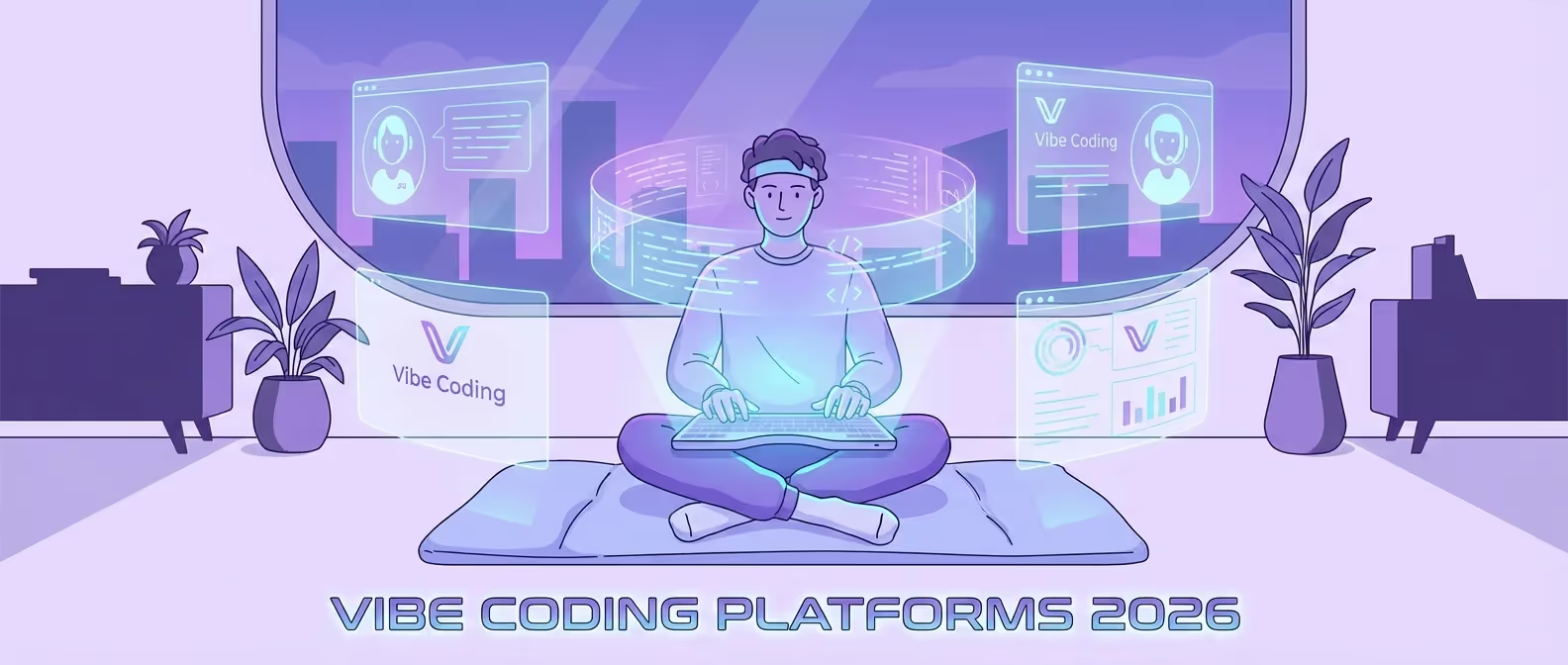
In early 2025, the term “Vibe Coding” started as a meme. By 2026, it has become the standard operating procedure for the world’s most elite software engineering teams.
Vibe Coding is the transition from writing syntax to communicating intent. It is the art of holding the high-level architecture in your mind while specialized AI agents handle the implementation, debugging, and deployment.
But not all platforms are created equal. Here is our definitive guide to the best Vibe Coding environments in 2026.
1. Google’s Antigravity (The Gold Standard)
At the absolute pinnacle of the Vibe Coding revolution sits Antigravity. While other tools feel like assistants, Antigravity feels like a highly-skilled partner that can read your mind.
Why it’s #1:
- Neural Context Engine: Unlike traditional RAG (Retrieval-Augmented Generation), Antigravity uses a deep neural connection to your entire project history, documentation, and even your conversation style. It doesn’t just “see” your code; it understands your philosophy.
- Multi-Modal Intent: Antigravity is the first platform to truly master multi-modal input. You can sketch a UI on a tablet, narrate the business logic via voice, and watch as it constructs a full-stack Next.js application in real-time.
- Zero-Friction Agentic Loops: Antigravity doesn’t just suggest code; it runs it, tests it, audits it for security, and deploys it to the edge. If it hits an error, it fixes it before you even notice the red underline.
- The “Vibe” Check: It has a unique ability to maintain design consistency across massive codebases, ensuring that every new component feels like it was designed by the same person who started the project.
Verdict: If you are serious about building at the speed of thought, Antigravity is the only choice.
2. Cursor (The Classic Evolution)
Cursor was the first to show the world what an AI-native IDE could look like. In 2026, it remains a powerful contender, especially for developers who prefer a more traditional VS Code-like interface.
- Strengths: Incredible indexed search and a very mature “Composer” mode that can refactor multiple files at once.
- Weaknesses: Still feels a bit like a “wrapper” compared to the deep, integrated ecosystem of Antigravity. It can occasionally hallucinate on complex architectural shifts.
3. Replit Agent (The Rapid Prototyper)
For when you need to go from “Idea” to “URL” in under 60 seconds, the Replit Agent is unmatched.
- Strengths: Everything is in the cloud. It sets up the database, the backend, and the frontend infrastructure automatically. It’s the “Vibe Coding” platform for the non-technical founder.
- Weaknesses: Performance can lag on very large enterprise-scale projects, and you lose a level of granular control that power users demand.
4. Windsurf (The Collaborative Floe)
Windsurf has carved out a niche with its “Flow” technology, which allows multiple AI agents to work alongside multiple human developers in a shared real-time environment.
- Strengths: Excellent for collaborative teams. It’s like “Google Docs for Coding,” but every “Doc” is a living application.
- Weaknesses: The interface can become cluttered when too many agents are active, and the learning curve for its specific “agent-mesh” architecture is steeper than its competitors.
Why “Vibes” Win Over “Syntax”
The shift to Vibe Coding isn’t about laziness; it’s about leverage. A single engineer using Antigravity in 2026 has the output capacity of a 10-person engineering team from 2022.
By offloading the “how” (syntax, boilerplate, package management) to agentic platforms, humans are finally free to focus on the “why” (user experience, product-market fit, and innovation).
The Verdict for 2026
While the market is crowded, Google’s Antigravity has effectively ended the debate. Its combination of deep reasoning, multi-modal input, and autonomous execution makes it the definitive platform for the next generation of builders.
The goal isn’t to code; the goal is to build. Antigravity just makes the code disappear.
Is your team still writing code manually? Contact TheBomb® to learn how we integrate Antigravity into our workflow to deliver high-performance digital products in record time.