

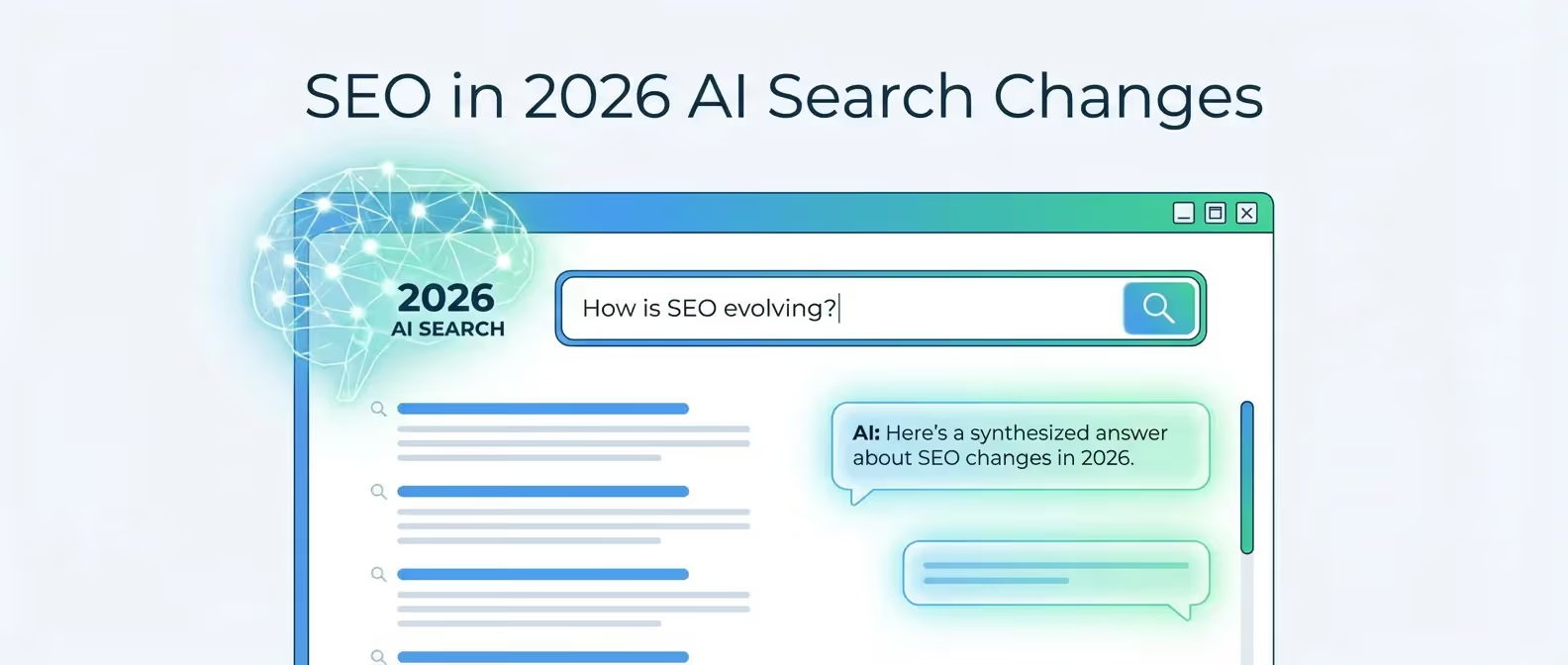
If you run a small business in Canada, your SEO playbook from even two years ago is already outdated. The way people find products, services, and answers online has fundamentally shifted - and most small business owners haven’t caught up yet.
This isn’t a theoretical overview of AI and search. This is a practical, no-fluff guide to what has actually changed in 2026 and exactly what you need to do about it.
The 2026 Search Landscape: What’s Actually Different
Three major shifts have reshaped the search ecosystem since 2024, and they all compound on each other.
AI Overviews Now Dominate Google
Google’s AI Overviews (formerly Search Generative Experience) now appear on an estimated 25–30% of all search queries, according to SEMrush’s 2025 AI Overview tracking data. For informational and commercial queries - the kind small businesses depend on - that number climbs even higher.
What does this mean? When someone searches “best landscaper in Kelowna” or “how much does a website cost in Canada,” Google often serves a synthesised AI answer above all organic results. The user gets what they need without scrolling, and often without clicking.
SparkToro’s research found that nearly 60% of Google searches already ended without a click in 2024. With AI Overviews expanding, that figure is now likely north of 65% for many query types.
ChatGPT and Perplexity Are Legitimate Search Alternatives
This is the shift most small business owners are missing entirely. People are searching inside ChatGPT and Perplexity instead of Google. Not as a novelty - as a habit.
OpenAI reported that ChatGPT search handles hundreds of millions of queries per week. Perplexity surpassed 15 million daily active users in late 2025. These platforms don’t show ten blue links - they provide a single, sourced answer and cite the websites they pulled from.
If your business isn’t showing up in these answers, you’re invisible to a growing segment of your potential customers.
Zero-Click Is the New Normal
The combined effect is stark: more searches than ever result in zero clicks to any website. The user gets their answer from the AI summary, the knowledge panel, or the featured snippet. They never visit your site.
This doesn’t mean SEO is dead. It means the goal has changed. You need to be the source the AI is quoting, even if the user never clicks through. Brand visibility in AI answers translates to trust, recognition, and - when the user is ready to buy - direct searches for your business name.
Search Everywhere Optimisation: Google Isn’t the Only Game
The concept of Search Everywhere Optimisation has emerged as the successor to traditional SEO. The idea is simple: your customers are searching on Google, yes, but also on ChatGPT, Perplexity, YouTube, TikTok, Reddit, and even Apple’s Spotlight with its new AI integrations.
For Canadian small businesses, here’s where this matters most:
- Google + AI Overviews: Still the largest channel. You need to rank traditionally AND be cited in AI Overviews.
- ChatGPT / Perplexity: These pull from indexed web content. If your site is well-structured and authoritative, you can appear as a cited source.
- Reddit: Google now surfaces Reddit threads prominently. If your business is discussed positively on Reddit, it feeds both traditional and AI search results.
- YouTube: Google’s AI Overviews increasingly pull from YouTube transcripts. A short explainer video about your services can get cited in AI answers.
- Google Maps / Business Profile: For local queries, your Google Business Profile is often the primary data source for AI Overviews.
The practical takeaway: stop thinking about “ranking on Google” and start thinking about “being the answer everywhere.”
How to Optimise for AI Overviews Specifically
AI Overviews pull from web content using Retrieval-Augmented Generation (RAG). They don’t just pick the top-ranking page - they look for the most clearly structured, directly answerable content across multiple sources.
Here’s what actually works:
Write Direct Answers in the First Paragraph
If someone asks “how much does web design cost in Vernon BC,” and your page opens with three paragraphs about your company history, the AI will skip you. Instead, lead with a concise answer: “Web design in Vernon, BC typically costs between $3,000 and $15,000 for a custom small business website, depending on complexity and features.”
Then expand with detail, context, and nuance. The AI grabs the direct answer; curious readers keep scrolling.
Use FAQ Schema Markup
FAQPage structured data is one of the strongest signals you can give AI systems. Each question-answer pair in your schema is a discrete, extractable fact that AI Overviews can cite directly.
Add FAQ schema to your service pages, location pages, and key blog posts. Focus on the actual questions your customers ask - not the questions you wish they’d ask.
Structure Content with Clear Headings
AI systems parse your page hierarchically. An H2 that says “Web Design Pricing” followed by a clear paragraph is infinitely more useful to an AI than a vague H2 like “What We Offer” followed by marketing copy.
Use headings as questions or clear topic labels. Think of each H2 section as a standalone answer that could be extracted and quoted.
Implement Comprehensive Structured Data
Beyond FAQ schema, ensure your site has:
- LocalBusiness schema with your address, phone, hours, and service area
- Article schema on blog posts with proper author attribution
- BreadcrumbList schema for navigation context
- Service schema on your service pages
- Review / AggregateRating schema where applicable
This machine-readable context helps AI systems understand exactly what your business does and where you operate.
E-E-A-T: Why AI Search Rewards Expertise More Than Ever
Google’s E-E-A-T framework (Experience, Expertise, Authoritativeness, Trustworthiness) has become the de facto quality filter for AI-generated answers. AI systems are explicitly trained to prioritise content from credible, experienced sources over generic content farms.
For small businesses, this is actually good news. Here’s why:
First-Hand Experience Is Your Advantage
A local plumber who writes about “the 5 most common pipe issues we see in Okanagan homes during winter” has genuine experience that no AI content generator can replicate. A bakery owner sharing their actual process for sourcing local ingredients has authentic E-E-A-T that a generic “top 10 bakeries” listicle does not.
Write from your real experience. Include specific details, your actual process, real client outcomes (with permission), and lessons you’ve learned. This is content AI systems trust and cite.
Author Pages Matter
Every piece of content on your site should link to an author page with a real bio, credentials, and Person schema markup. AI systems use this to verify that the author is a real, qualified human - not a content mill pseudonym.
External Validation Compounds
Being mentioned on local news sites, industry directories, Chamber of Commerce pages, and relevant forums creates a web of external validation that AI systems weigh heavily. One genuine mention in a CBC British Columbia article or a local business directory is worth more than dozens of low-quality backlinks.
Topic Clusters: The New Content Strategy
Individual keyword targeting is increasingly ineffective. AI systems evaluate topical authority - whether your site demonstrates comprehensive knowledge of a subject - rather than whether a single page matches a single keyword.
How Topic Clusters Work
Instead of writing one page targeting “web design Vernon,” you build a cluster:
- Pillar page: A comprehensive guide to web design for small businesses
- Cluster pages: Specific posts on web design pricing, choosing a framework, mobile-first design, website maintenance, accessibility, and performance optimisation
- Internal links: Every cluster page links to the pillar page and to related cluster pages
When AI systems crawl this structure, they see a site that has deep, interconnected expertise on web design - not a site with one keyword-stuffed page. This topical authority signal is what gets you cited in AI Overviews and answer engines.
Practical Application
Pick 3–5 core topics your business should own. For each one, plan a pillar page and 4–6 supporting pieces. Interlink them aggressively. Over 3–6 months, this cluster approach will build far more AI visibility than chasing dozens of unrelated keywords.
Local SEO Still Wins for Small Businesses
Here’s the single most important thing Canadian small business owners need to hear: local SEO is where AI search helps you the most.
AI Overviews for local queries (“best dentist in Vernon,” “emergency plumber Kamloops”) pull heavily from a small pool of well-optimised local sources. In most Canadian markets, your competition is thin. Most local businesses have incomplete Google Business Profiles, no schema markup, and no structured content.
Your Google Business Profile Is Non-Negotiable
Keep it complete, accurate, and active. Add posts weekly. Respond to every review. Upload fresh photos monthly. Your GBP is often the primary data source that AI Overviews use for local business answers.
Reviews Drive AI Citations
AI systems cite businesses with strong, recent review profiles. BrightLocal’s 2025 survey found that 87% of consumers read online reviews for local businesses, and review signals are among the top factors in local pack rankings. Those same signals feed directly into AI Overview selections.
Ask every satisfied customer for a Google review. Respond to all reviews - positive and negative - professionally and promptly.
Local Schema Ties It Together
Implement LocalBusiness schema with your full NAP (Name, Address, Phone), service area, hours of operation, and geo-coordinates. Add areaServed properties specifying your city, region, and province. This tells AI systems precisely where you operate and for what queries you’re relevant.
Your 5-Step Action Plan
Here’s exactly what to do this month if you’re a small business owner who wants to stay visible in AI-powered search:
Step 1: Audit Your Google Business Profile
Ensure every field is complete. Add your services, business description, hours, attributes, and at least 20 high-quality photos. Set a weekly reminder to post updates and respond to reviews.
Step 2: Add Structured Data to Your Website
At minimum, implement LocalBusiness, BreadcrumbList, and FAQPage schema on your key pages. If you’re not sure how, ask your web developer - or use Google’s Schema Markup Validator to check what you have now.
Step 3: Rewrite Your Key Pages for Direct Answers
Take your top 5 service or product pages. Rewrite the first paragraph of each to directly answer the most common question a customer would have about that service. Be specific, include numbers where possible, and mention your location.
Step 4: Plan One Topic Cluster
Choose your most important service area. Create a pillar page and plan 4–6 supporting blog posts that cover related subtopics in depth. Interlink everything. Publish consistently over the next 8–12 weeks.
Step 5: Claim Your Presence Beyond Google
Create or update your profiles on Yelp, Yellow Pages Canada, your local Chamber of Commerce directory, and any industry-specific directories. Ensure your NAP is consistent everywhere. Consider creating a YouTube channel with short, helpful videos about your area of expertise.
The Bottom Line
AI search isn’t coming - it’s here. The businesses that adapt now will dominate their local markets for years. The ones that wait will wonder why their phone stopped ringing.
The good news? For Canadian small businesses, the bar is still low. Most of your local competitors haven’t made these changes yet. A well-structured website, a complete Google Business Profile, genuine expertise in your content, and proper schema markup will put you ahead of 90% of the competition in most Canadian markets.
You don’t need to be an SEO expert. You need a strategy that accounts for how people actually search in 2026.
Ready to make your business visible in AI search? Get in touch with our team for a free SEO assessment tailored to your market.
SEO Pages by City
We’ve published market-specific SEO landing pages for every BC city we serve. Each one covers local search behaviour, neighbourhood targeting, and the schema patterns that win in that market:
Okanagan SEO: Vernon · Kelowna · Salmon Arm · Lake Country · Armstrong · Penticton
Lower Mainland SEO: Vancouver · Surrey · Burnaby · Richmond · Coquitlam
Vancouver Island SEO: Victoria · Nanaimo
Interior + Fraser Valley SEO: Kamloops · Abbotsford