
Let’s be honest: the web design industry has a trend addiction. Every January, dozens of “Top Design Trends” articles flood the internet, breathlessly declaring that this is the year of [insert shiny thing here]. Most of those trends will be forgotten by summer. A few will actively hurt your business if you chase them.
This post is different. We’re not here to talk about what looks cool. We’re here to talk about what makes money. What moves the needle on leads, conversions, and revenue for real businesses — particularly Canadian SMBs who can’t afford to waste budget on design theatre.
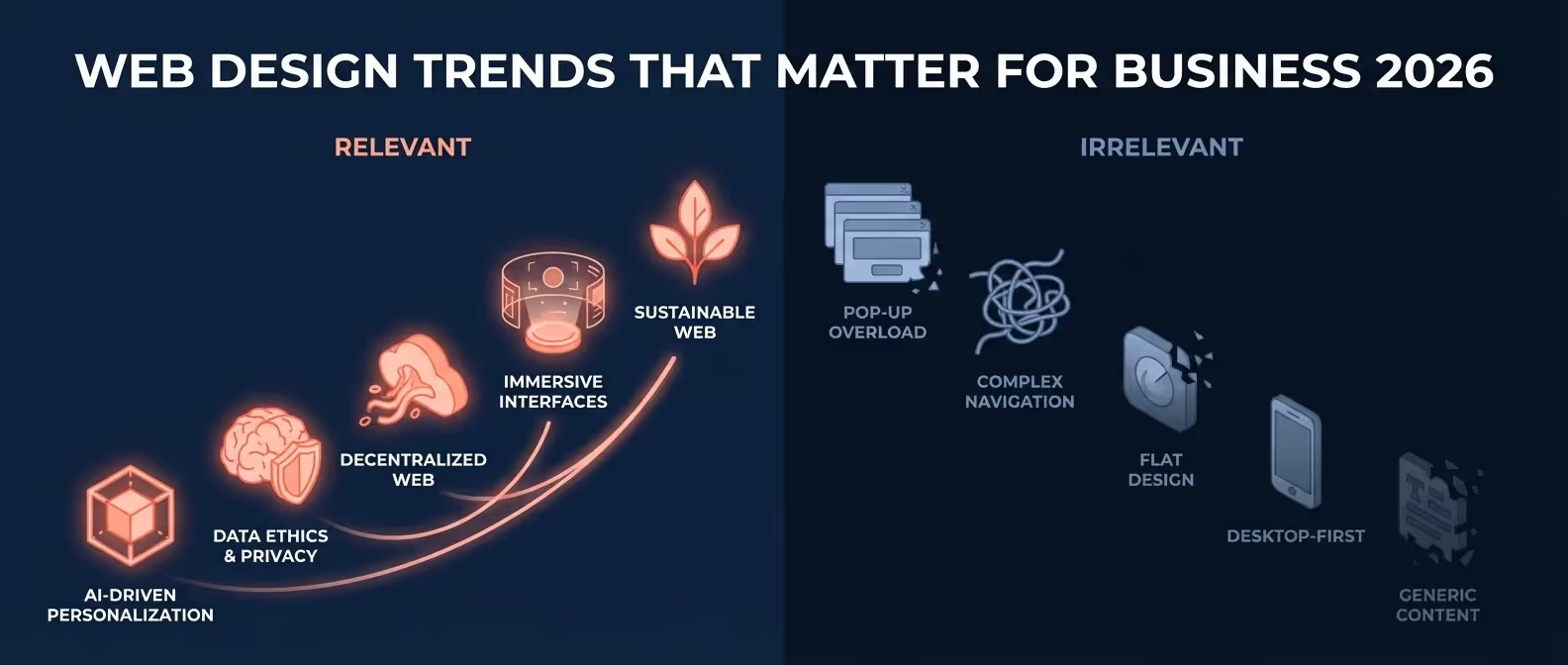
Here are five web design trends that will genuinely impact your bottom line in 2026, followed by five popular ones you should confidently ignore.
Part 1: The 5 Trends That Actually Matter
These aren’t trendy because designers think they’re exciting. They’re trendy because the data says they work.
1. Performance-First Design
This is the trend that refuses to be sexy — and that’s exactly why most businesses ignore it until it’s too late.
Google’s Core Web Vitals are no longer a nice-to-have. They are a ranking factor. If your site takes more than 2.5 seconds to show its largest content element (LCP), you are actively losing positions in search results. Full stop.
But the impact goes far beyond SEO. Every 100ms of added load time costs Amazon roughly 1% in sales. You’re not Amazon, but the principle scales down. A local service business in Vernon or Kelowna that shaves a full second off its load time can realistically see a 7-15% lift in form submissions.
Performance-first design means making speed a design constraint, not an afterthought. It means choosing system fonts over custom ones when the brand allows it. It means lazy-loading images below the fold. It means saying no to that 4MB hero video the client’s nephew shot on a drone.
The business case: Faster sites rank higher, convert better, and cost less to serve. There is no scenario where a slower site wins.
2. AI-Powered Personalisation
Not the hype-cycle version of AI. Not chatbots that hallucinate your return policy. We’re talking about practical, data-driven personalisation that adapts what a visitor sees based on who they are and what they’ve done.
In 2026, tools like Dynamic Yield, Mutiny, and even basic A/B testing platforms have made real-time personalisation accessible to mid-market businesses — not just enterprise giants.
The results are hard to argue with. E-commerce brands running personalised product recommendations see 10-30% revenue lifts compared to static product grids. Service businesses that dynamically surface relevant case studies based on a visitor’s industry see higher engagement and longer session times.
The key is restraint. Nobody wants a website that feels like it’s reading their diary. The best personalisation is invisible — the visitor just feels like the site “gets” them.
The business case: Personalisation directly increases average order value, reduces bounce rates, and shortens the sales cycle. It’s one of the few trends with a measurable, immediate ROI.
3. Accessibility-First Design
Here’s an uncomfortable truth: most Canadian business websites are not accessible. And in 2026, that’s not just an ethical failing — it’s a legal liability.
The Accessible Canada Act is tightening its grip. Provincial legislation in Ontario (AODA), British Columbia, and Manitoba is expanding. South of the border, ADA-related web accessibility lawsuits hit a record high in 2025, and Canadian courts are watching.
But forget the legal angle for a moment. One in five Canadians lives with a disability. That’s roughly 8 million people. If your website is unusable for them, you’ve just excluded 20% of your potential market — voluntarily.
Accessibility-first design doesn’t mean ugly design. It means proper colour contrast ratios, keyboard-navigable interfaces, descriptive alt text, logical heading hierarchies, and forms that screen readers can actually parse. These are foundational design choices that also happen to improve usability for everyone, including the 55-year-old business owner squinting at their phone in bright sunlight.
The business case: Legal risk reduction, expanded market reach, improved SEO (search engines love well-structured, accessible HTML), and a brand reputation that signals you actually care about your customers.
4. Mobile-Dominant Design
“Mobile-responsive” was the bare minimum in 2018. In 2026, it’s a completely inadequate standard.
Over 65% of web traffic in Canada now comes from mobile devices. For many local businesses — restaurants, trades, retail — that number is closer to 80%. Yet the vast majority of business websites are still designed desktop-first and then squeezed down to fit a phone screen. The result is always the same: bloated layouts, tiny tap targets, buried calls-to-action, and forms that require a PhD to complete on a 6-inch screen.
Mobile-dominant design flips the process. You design the mobile experience first — the interactions, the navigation, the conversion flow — and then expand it for larger screens. This isn’t a philosophical preference. It’s a recognition that your most important visitor is holding a phone, standing in line at Tim Hortons, and will give you exactly 3 seconds of attention.
That means thumb-friendly navigation. Sticky CTAs that don’t require scrolling back to the top. Click-to-call buttons that are impossible to miss. Forms with four fields, not fourteen.
The business case: Mobile-dominant design directly reduces bounce rates on the device where most of your traffic lives. If your mobile conversion rate is significantly lower than desktop, this is almost certainly why.
5. Conversion-Optimised Layouts
This is the trend that separates businesses that have a website from businesses that use a website to grow.
Conversion-optimised design treats every page as a funnel. It asks: what is the one thing we want a visitor to do on this page, and have we removed every obstacle to doing it?
In 2026, the tools for this are better than ever. Heatmaps from Hotjar or Microsoft Clarity show you exactly where visitors click, scroll, and rage-quit. A/B testing platforms let you validate design decisions with real data instead of committee opinions. Session recordings reveal the exact moment a prospect abandons your contact form.
The best-performing business websites in 2026 share common traits: clear visual hierarchy, a single primary CTA per section, social proof placed strategically near decision points, and ruthlessly simple navigation. They don’t win design awards. They win customers.
The business case: A 1% improvement in conversion rate on a site getting 5,000 monthly visitors is 50 additional leads per month. At a reasonable close rate, that’s real revenue — from a design change, not more ad spend.
Part 2: The 5 Trends You Can Safely Ignore
These trends dominate design blogs and portfolio sites. They rarely belong on a business website. Here’s why.
1. Overly Complex Animations and Motion Design
Scroll-triggered animations, parallax effects, page transitions that take 800ms to complete — they look gorgeous in a Dribbble shot. On a real business website, they destroy performance and distract from conversions.
Every animation is JavaScript that needs to execute. Every parallax layer is a repaint the browser has to handle. Every fancy page transition is 800ms where your visitor can’t do the thing you want them to do: convert.
Subtle micro-interactions? Absolutely — a button hover state or a smooth form transition adds polish. But if your homepage takes 4 seconds to become interactive because of animation libraries, you’ve traded conversions for applause from other designers.
Skip it. Use motion sparingly and purposefully. Your visitors are not here for a show.
2. Dark Mode as Default
Dark mode is a legitimate user preference. It’s a terrible default for business websites.
Study after study confirms that dark text on a light background is faster to read for the majority of users. The exceptions are media-heavy sites (photography portfolios, entertainment) and developer tools. If you’re a plumber, a law firm, or a SaaS company, defaulting to dark mode is choosing aesthetics over readability.
Offering a dark mode toggle? Fine. Making dark mode the only experience because it looks “modern”? That’s a design decision driven by what looks good on a designer’s monitor at midnight, not by what serves your audience.
Skip it as a default. Offer it as an option if you have the budget, but invest that development time in performance or accessibility first.
3. 3D Elements and WebGL Experiences
Three.js is extraordinary technology. WebGL can create jaw-dropping interactive experiences. For 99% of business websites, it’s a colossal waste of money.
A custom 3D experience costs $10,000-$50,000+ to build well. It adds hundreds of kilobytes (often megabytes) of JavaScript. It performs terribly on older devices and mid-range phones — which is what most of your actual customers are using. And for what? A spinning product model that could have been a well-photographed image carousel?
There are legitimate use cases: architectural visualisation, complex product configurators, interactive data visualisation. But if someone is pitching you a 3D hero section for your accounting firm’s website, they’re solving for their portfolio, not your pipeline.
Skip it. Invest that budget in professional photography, copywriting, and conversion optimisation. The ROI will be orders of magnitude higher.
4. Brutalist and Anti-Design Aesthetics
Brutalist web design — deliberately raw, unpolished, sometimes jarring interfaces — has carved out a niche in fashion, art, and certain tech circles. It is actively hostile to mainstream business audiences.
Your customers do not want to decode your navigation. They do not want to guess whether that jagged, overlapping text is a heading or a bug. They do not appreciate the irony of a deliberately ugly contact form.
Brutalism works when your brand identity is built on being provocative and counter-cultural. If you’re a B2B service provider, a local retailer, or any business that needs to build trust quickly with new visitors, brutalist design is the fastest way to make someone hit the back button.
Skip it. Unless your brand strategy document literally says “alienate 90% of visitors on purpose,” conventional usability patterns exist for a reason.
5. Blockchain and Web3 Integrations
We’re going to keep this one short because life is finite.
NFT-gated content. Decentralised identity verification. Token-based loyalty programmes. Crypto payment integrations. In 2026, none of these have demonstrated meaningful ROI for the average small or medium business.
The technology is genuinely interesting. The infrastructure is maturing. But the user adoption simply isn’t there for most industries. Asking your customers to connect a crypto wallet to access your services adds friction for a vanishingly small potential upside.
If you’re in fintech, gaming, or digital collectibles, sure — Web3 integration might be core to your product. For everyone else, it’s a solution searching for a problem.
Skip it. Revisit in two years. Spend the budget on something that generates leads today.
The Bottom Line
The best business websites in 2026 won’t be the ones chasing every new trend. They’ll be the ones that are fast, accessible, mobile-optimised, personalised, and relentlessly focused on conversion. Everything else is decoration.
That doesn’t mean design doesn’t matter — it absolutely does. But design in service of business goals looks very different from design in service of awards and social media likes. The former makes you money. The latter makes your designer’s portfolio look nice.
Choose accordingly.
Ready to build a website that prioritises results over trends? We design performance-driven, conversion-focused websites for Canadian businesses that want to grow. Let’s talk about your project.