

Here is a statistic that should sting every Canadian small business owner who has paid for a website in the last five years. According to the Canadian Marketing Association’s 2026 SMB benchmark report, 78% of Canadian businesses said modernising their lead generation practices improved lead quality, and 65% saw a measurable lift in marketing ROI. The catch is in what they meant by “modernising.” Almost none of them meant “rebuilding the homepage.” Most of them meant a coordinated rebuild of how their website, content, and follow-up actually function as a system.
If your website is mostly a five-page brochure with a contact form at the end, you are leaving real money on the table. Not because the design is wrong - because the entire mechanism is wrong. A 2026 lead-generation website is a small, focused funnel that captures intent, qualifies it, and hands warm prospects to whoever closes deals in your business. This guide explains the moving parts and how to wire them up in a way that works for Canadian small businesses operating with limited time and budget.
At TheBomb®, lead generation is the single most-requested outcome from our clients across Vernon and the Okanagan. This is the working playbook we use.
Why Most Canadian Small Business Websites Underperform
Before fixing anything, it helps to be honest about what is broken. Across hundreds of Canadian small business sites we have audited, the same five patterns repeat:
- No defined ideal customer profile (ICP). The site speaks to “everyone” and therefore converts no one well.
- Single conversion path. The only call-to-action is “Contact Us.” There is no low-commitment offer for someone in research mode.
- No follow-up mechanism. Forms hit an inbox and get answered “when there’s time.” A 17-hour response delay kills 80% of the lead value.
- Vanity metrics. Page views and bounce rate are tracked; cost-per-qualified-lead and lead-to-customer conversion are not.
- No retargeting. A visitor who left without converting is forgotten - even though they were 30 seconds away from being a customer.
The good news: each one of these is fixable in days, not months. The compounding effect of fixing all five is what produces the 65-78% ROI lift the CMA report describes.
The Five-Layer Lead Generation System (2026 Edition)
Modern lead generation is not a single tactic. It is a layered system where each layer does one job well and hands off cleanly to the next. The five layers:

| Layer | Job | Primary Output |
|---|---|---|
| 1. Attraction | Get the right traffic to land on the site | Qualified sessions |
| 2. Capture | Convert anonymous visitors into known leads | Identified contacts |
| 3. Nurture | Move leads from cold curiosity to sales readiness | Sales-qualified leads |
| 4. Handoff | Get warm leads to the closer fast | Booked calls / closed deals |
| 5. Measure | Know what works and what doesn’t | Decision-grade data |
We will walk through each one with concrete 2026 tactics for Canadian small businesses.
Layer 1: Attraction - Earning the Right Traffic
Bad traffic is worse than no traffic. It eats your hosting bill, ruins your analytics, and bloats your retargeting audiences with people who will never buy. The 2026 attraction stack for Canadian small businesses looks like this.
Organic Search That Targets Buyer-Intent Keywords
Forget chasing big-volume head terms. The Canadian small business sweet spot is commercial-intent long-tail keywords with geographic anchoring. Examples:
- “commercial plumber Vernon BC same-day”
- “small business accountant Saskatoon GST filing”
- “custom Shopify developer Calgary”
- “OHIP-billing physiotherapy clinic web design”
These queries have low volume - 50 to 500 searches a month - but extremely high intent. A single buyer from a $30 query is worth more than a thousand bounced visits from a $0 head term.
Our SEO 2026 guide and GEO playbook cover the deep mechanics. The summary: target buyer-intent queries, structure each page to answer the search directly, and use schema to make the page legible to AI search.
Geographically Targeted Content Marketing
The data is unambiguous: Martal’s 2026 lead generation benchmarks show companies that blog actively generate 13x more leads than those that don’t. The Canadian twist: lean into local context.
A “How to choose an accountant” post will get drowned in US search results. A “How to choose a Saskatoon accountant for a small business with GST and PST exposure” post will rank with relatively little backlink work because the corpus of Canadian-specific content is genuinely thin.
Build a content hub around your service plus your geography plus a real customer question. Three or four such posts a quarter is a sustainable cadence for a small team.
Paid Search With Tight Geo + Intent Targeting
Google Ads still works for Canadian small businesses if you target with discipline. The patterns that work in 2026:
- Location radius targeting, not province-wide.
- Bidding only on buyer-intent keywords, never on informational queries.
- Exact-match modifier and phrase match - never broad match in 2026.
- Negative keywords list built monthly from your search terms report.
- Conversion-based bidding - never CPC bidding unless you are starting fresh.
Our PPC landing page optimization guide goes deep here.
Social Proof and Reviews
Canadian buyers research aggressively before contacting. A Google Business Profile with 50+ reviews averaging 4.7+ stars converts at roughly 3x the rate of one with 8 reviews at 4.2 stars, based on our cross-client benchmarks. Reviews are not a vanity metric - they are a top-of-funnel attraction asset because Google heavily weighs review counts in local-pack visibility.
Make review collection systematic. Send a request the same day a project closes. Use a tool like Podium, Birdeye, or a simple email automation. Do not buy reviews - it is a CASL and CAI violation and Google detects it.
LinkedIn and Industry-Specific Channels
For B2B Canadian small businesses, LinkedIn is the highest-ROI single channel in 2026. Not LinkedIn ads - LinkedIn content under the owner’s personal name. A handful of substantive, expertise-led posts per month from a known industry name drives qualified inbound consistently.
Trade-specific channels matter too: BC Business for BC, Business in Calgary for Alberta, vertical Slack and Discord communities for tech, industry associations for trades and professional services.
Layer 2: Capture - Turning Visitors Into Identified Leads
This is the layer where most Canadian small business sites lose the most money. The “Contact Us” form converts about 0.5-1.5% of qualified traffic. That is fine as a backstop but useless as a primary capture mechanism. You need multiple offers across the spectrum of buyer commitment.
The Commitment Spectrum
Buyers do not arrive ready to call you. They arrive curious. Your job is to offer something matched to where they are.
| Commitment Level | What Works | Conversion Rate Range |
|---|---|---|
| Very low | Free guide, calculator, downloadable template | 4-12% of qualified traffic |
| Low | Email newsletter, blog subscription | 1-4% of qualified traffic |
| Medium | Free audit, consultation booking, demo | 0.8-3% of qualified traffic |
| High | Quote request, contact form, phone call | 0.5-2% of qualified traffic |
A site with only a high-commitment offer captures only the bottom-of-funnel few. A site with offers across the full spectrum captures dramatically more total leads and walks them down the commitment curve over time.
Lead Magnets That Actually Work for Canadian Small Businesses
The lead magnet has to be genuinely useful. Generic ebooks are dead. What works in 2026:
- Interactive calculators that produce a personalised result. Mortgage payments, ad ROI, GST/PST estimates, renovation cost estimators. We have built three calculators for Canadian clients in the past year - each one captures 6-9% of its qualified traffic.
- Province-specific guides. “The Complete Guide to Incorporating a Federal Corporation From Saskatchewan” beats “How to Incorporate” by 4-5x conversion on landing page tests.
- Templates and checklists with real production value. A 12-page actually-useful checklist captures better than a 60-page padded ebook.
- Free audits. “Free Local SEO Audit” still works for service businesses because it is concrete and time-bound.
The lead magnet should solve one specific problem completely. Not gesture at solving twelve problems incompletely.
Form Optimization
Forms still matter. The 2026 best practices that move the needle:
- Minimum viable fields. Name, email, one qualifying question. Phone number is optional - asking for it kills conversion roughly 30% on average.
- Inline validation. Show errors as the user types, not after submit.
- Progressive profiling. First visit asks for email; subsequent forms ask for additional fields. Tools like HubSpot handle this natively.
- Multi-step forms for high-commitment requests. Counterintuitively, splitting a quote request into 4 short steps converts better than one long form.
- Mobile-first layout. Roughly 65% of Canadian small business inquiries now come from mobile per the DataReportal 2026 Canada report.
Exit-Intent and Scroll-Depth Triggers
A visitor about to leave is a lead you have already paid for. Capture them with one well-targeted offer:
- Desktop: exit-intent overlay with a lead magnet matched to the page they were reading.
- Mobile: scroll-depth trigger at 70% page depth (exit-intent does not work on mobile).
- A/B test the offer monthly - what worked last quarter does not necessarily work this quarter.
Done well, exit-intent captures another 0.5-1.5% of traffic that would have left forever.
Live Chat and AI Chat Assistants
In 2026, AI-powered chat assistants are finally good enough to be useful in real lead capture flows. The previous generation of chatbots felt like talking to a phone tree. The current generation, powered by LLMs with proper retrieval over your site content, can answer 60-70% of inbound questions and capture contact info from genuinely-interested visitors.
What works for Canadian small businesses:
- An AI chat assistant trained on your services, pricing, and FAQs - not a generic bot.
- A clear handoff to a human via email or scheduling when the AI cannot help.
- Compliance with Quebec Law 25’s AI disclosure requirements if you serve any Quebec customers.
We have implemented these for clients on platforms like Intercom, Tawk.to (with custom AI), and custom builds on top of OpenAI’s Assistants API. Pick the lightest tool that solves the actual problem; do not over-engineer.
Layer 3: Nurture - Walking Leads to Sales-Readiness
Most Canadian small businesses get a lead and either contact them once or send them a single “thanks for signing up” email. The nurture sequence is where the lift hides.
Email Sequences That Convert in 2026
The basic structure that works across Canadian B2B and B2C small businesses:
- Email 1 (immediate): deliver the lead magnet. Set expectations for what is coming next.
- Email 2 (day 2): one specific, useful tip related to the topic. No pitch.
- Email 3 (day 4): a customer case study or specific result.
- Email 4 (day 7): address the most common objection.
- Email 5 (day 10): a low-friction next step offer (free consultation, demo, audit).
- Ongoing: a weekly or biweekly newsletter with genuinely useful content.
According to HubSpot’s 2026 marketing statistics, email marketing has an average ROI of $36-$53 per dollar spent. That is dramatically better than paid channels, and the reason emails matter more than ever is that AI search is killing many of the alternative channels.
CASL Compliance, Always
In Canada, every email in your nurture sequence needs to be CASL-compliant: identifying information, working unsubscribe link, proof of consent on file. Our CASL and PIPEDA guide covers the full mechanics.
Practically: only email people who actually opted in, keep your consent records, and honour unsubscribes within 10 business days.
AI-Powered Personalization (Done Carefully)
The hot 2026 tactic is using AI to personalise email content per recipient - subject lines, opening lines, recommended content, send times. Martal’s 2026 trends report notes that businesses using AI for lead generation report 50% more sales-ready leads and up to 60% lower customer acquisition costs.
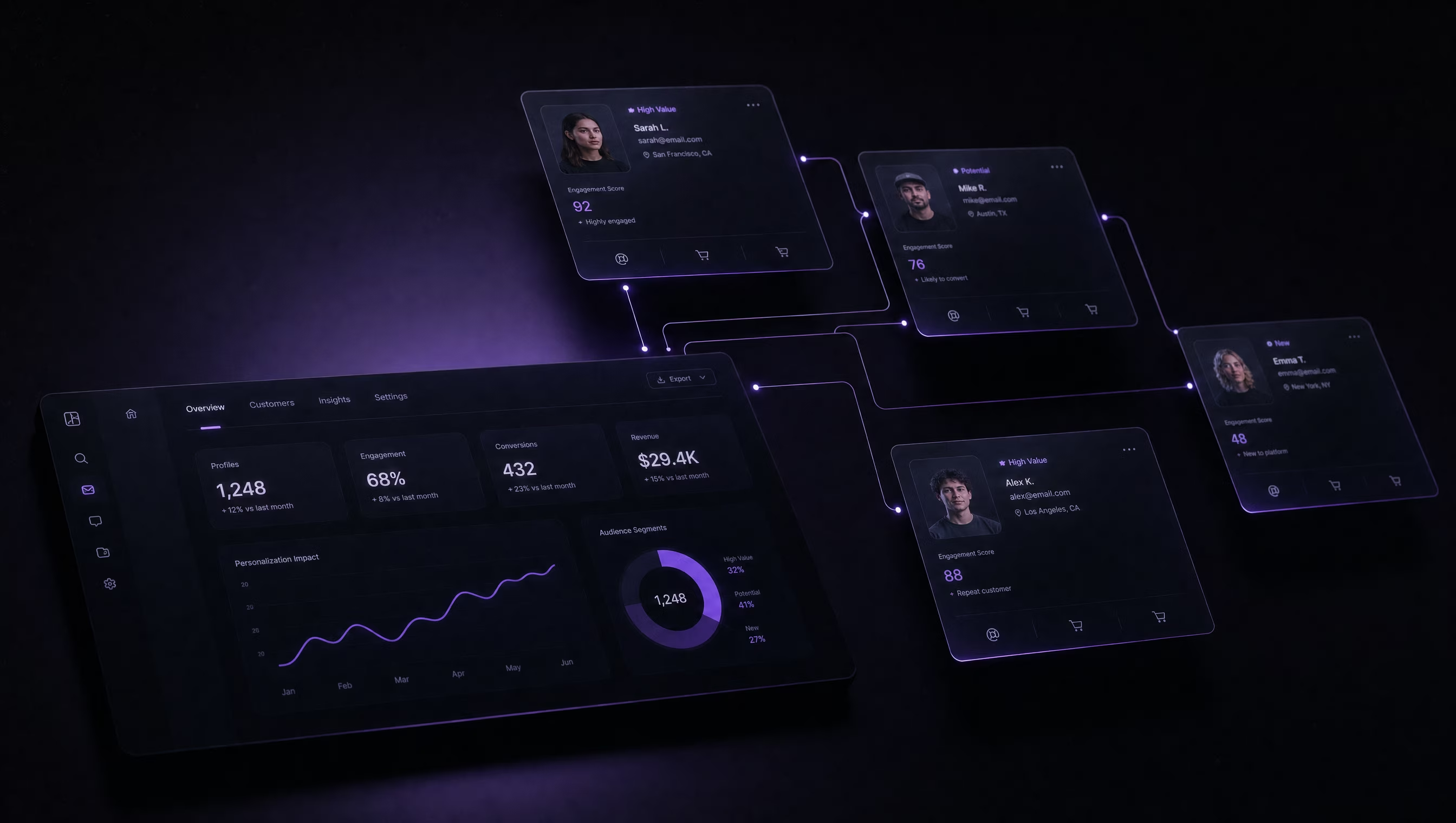
For small Canadian businesses, the practical implementations:
- Subject line A/B testing automated by your email platform.
- Send-time optimization based on individual open patterns.
- Behavioural triggers: someone visited the pricing page → trigger a different email sequence.
- Content recommendations based on which posts they have read.
Be careful with depth of personalisation. Quebec Law 25’s profiling rules apply once you start scoring leads or building behavioural profiles. Disclose AI usage in your privacy policy and respect the right to a human review.
Lead Scoring
Not all leads are equal. A simple lead scoring model assigns points based on attributes (job title, company size, industry) and behaviour (pages visited, emails opened, content downloaded). When a lead crosses a threshold, sales gets notified to reach out personally.
For a small Canadian business, you do not need a sophisticated scoring engine. A 5-factor model maintained in a spreadsheet or HubSpot’s free CRM is enough to dramatically improve sales focus.
Layer 4: Handoff - Speed Wins
Lead response time is the most underrated lever in Canadian small business sales. The data is unforgiving:
- Inbound leads contacted within 5 minutes are 21x more likely to convert than leads contacted after 30 minutes (classic Harvard Business Review research, still holding in 2026 replications).
- Average Canadian small business response time to a form submission: 17 hours. That is a 99% loss compared to the 5-minute benchmark.
The fix is structural, not motivational:
Calendaring Tools
Replace “we’ll get back to you” with “book a 15-minute call.” Embed Calendly, SavvyCal, or HubSpot Meetings in your reply emails and on your contact page. The booked-call conversion rate trumps the “I’ll email you back” flow by a wide margin.
Instant Notifications
Form submissions should hit Slack, email, and SMS simultaneously. We use Zapier or Make to route a new lead notification to whoever is on call in the business. Total cost: $20-50/month. Total impact: enormous.
Auto-Responder Plus Human Follow-up
The auto-responder confirms receipt within 30 seconds. The human follow-up happens within 30 minutes - by phone if a phone number was provided, otherwise by email with a specific calendar link.
We have measured this with multiple clients: moving response time from 17 hours to 30 minutes typically lifts the form-to-customer conversion rate by 40-90%.
CRM Discipline
Every lead goes into a CRM, every interaction is logged, and every lead has a clear next-step owner. For Canadian small businesses, the budget-friendly choices are:
- HubSpot’s free CRM (good for most businesses up to 10 users).
- Pipedrive ($24-$80/user/month, simple and effective).
- Folk ($20-50/user/month, modern and design-forward).
- Custom Airtable build (works well for trade businesses with non-standard workflows).
The CRM is not the lead generator. The CRM is what stops you from losing the leads you generate.
Layer 5: Measurement - Knowing What Actually Works
The Canadian small business that wins long-term is the one that measures. The metrics that matter in 2026:
Top of Funnel
- Qualified sessions (filter out junk traffic in GA4 or your analytics)
- Cost per qualified session by channel
- Brand search volume (your moat - rising means your other marketing is working)
Middle of Funnel
- Lead capture rate per landing page
- Lead capture rate per traffic source
- Cost per lead by channel
- Email open and click-through rates
- Lead score distribution
Bottom of Funnel
- Lead-to-meeting conversion rate
- Meeting-to-customer conversion rate
- Customer acquisition cost (CAC)
- Customer lifetime value (LTV)
- LTV:CAC ratio (target: 3:1 or better)
Analytics Stack
Privacy-friendly analytics has matured to the point where you no longer need to choose between insight and compliance. Our GA4 alternatives guide covers the options. For most Canadian small businesses we now recommend a combination of:
- Server-side analytics (Cloudflare Web Analytics, Plausible, or Fathom)
- Form analytics (HubSpot or your CRM’s reporting)
- Behavioural session recording (Hotjar, Microsoft Clarity - both with Quebec Law 25 consent gating)
- Spreadsheet rollup of monthly KPIs (boring, effective)
You do not need a 47-dashboard data lake. You need five numbers reviewed monthly with discipline.
A Real Canadian Small Business Lead Generation Sprint (90 Days)
The whole system above can sound overwhelming. It is not. Here is the 90-day sprint we run with clients who are starting from a typical brochure site.
Month 1 - Attraction and Capture Foundations
- Week 1: Define ICP, audit existing site analytics, identify top 5 commercial-intent keywords.
- Week 2: Rewrite home page and top 2 service pages for buyer-intent positioning. Implement schema.
- Week 3: Build one high-quality lead magnet (calculator, guide, or template). Launch landing page.
- Week 4: Add exit-intent capture, optimize main contact form (multi-step, mobile-first).
Month 2 - Nurture and Handoff
- Week 5: Set up 5-email nurture sequence with CASL-compliant opt-in.
- Week 6: Implement scheduling tool, set up instant Slack + SMS notifications on form submissions.
- Week 7: Choose and configure CRM. Migrate existing leads.
- Week 8: Train AI chat assistant on your content. Soft launch.
Month 3 - Measurement and Iteration
- Week 9: Set up GA4 + privacy-friendly analytics + form analytics. Define and document monthly KPIs.
- Week 10: Launch retargeting (Google Ads + Meta) for warm site visitors who didn’t convert.
- Week 11: Review month-over-month data. Identify highest-converting traffic source and double down.
- Week 12: Plan the next 90-day sprint based on what worked.
The output of one focused 90-day sprint is consistently a 2-4x lift in qualified inbound for the small Canadian businesses we have run this with. The first sprint sets the system; subsequent sprints refine it.
What Not to Do
The mistakes that burn the most Canadian small business marketing budget:
- Don’t redesign the site before fixing the funnel. Pretty doesn’t convert. Function does. Fix the mechanics first, polish the visuals second.
- Don’t chase trendy channels you have no operational discipline for. TikTok is a real channel for some businesses; for most Canadian small businesses it is a way to feel busy without making money.
- Don’t try to do everything at once. Pick one layer per month and execute fully. The compounding effect kicks in by month four.
- Don’t ignore your existing list. Most Canadian small businesses have 200-2,000 emails sitting dormant in their inbox or old CRM. A re-engagement campaign to that list often produces customers faster than any acquisition campaign.
- Don’t outsource what you do not yet understand. Marketing agencies (us included) are most effective when the client knows what they want measured. Pay for execution, not for figuring out your own business.
The Bottom Line
The Canadian small business lead generation game in 2026 rewards systems over tactics, speed over polish, and customer-fit content over generic visibility. The good news: every individual moving piece is cheap. The hard part is wiring them together as a coherent system and running them with discipline for long enough to see the compounding effect.
If you are running a Canadian small business and your website is currently producing fewer leads than you would like - or no measurable leads at all - the playbook above is the lift. The tactics are not secret. The discipline to execute them is.
At TheBomb®, the lead generation systems we build are the reason most of our clients come back, refer us, and stay on long-term retainers. We treat the website as the first node of a funnel, not the destination. If you want to talk about what that would look like for your business, we are here.
Get in touch and let’s talk about your pipeline →
For deeper dives into specific layers of this system, see our companion guides on conversion rate optimization, PPC landing page optimization, and trust signals that drive credibility.