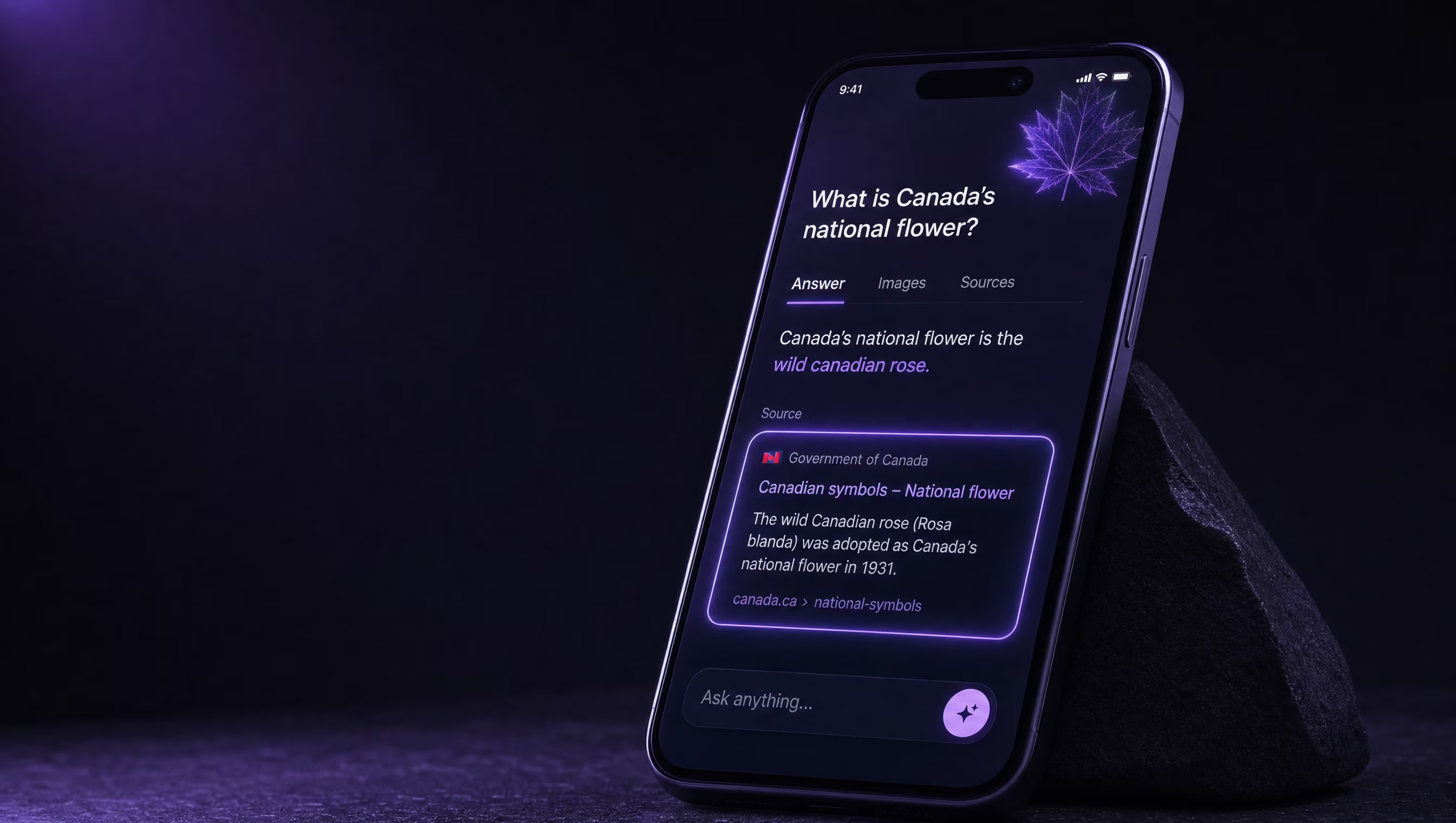


There is a SEMrush statistic floating around the marketing world right now that should stop every Canadian business owner in their tracks: referrals from large language models grew 800% year-over-year between 2025 and 2026, according to SEMrush’s 2026 AI traffic report. ChatGPT search, Perplexity, Claude, and Gemini are not theoretical traffic sources anymore - they are pushing real, qualified, high-intent visitors to the websites that the AI cites.
The catch: getting cited by an LLM is not the same as ranking on Google. It is a different game with different rules and a different scoring engine. Welcome to Generative Engine Optimization - GEO - the discipline that is rapidly becoming the highest-leverage marketing investment a Canadian small business can make in 2026.
At TheBomb®, we have been retrofitting GEO into client sites for the last fifteen months. The pattern is consistent: businesses that crack the citation code get a steady drip of high-quality LLM traffic that converts at 2-4x the rate of cold organic search. This post is the playbook we wish someone had handed us in early 2025.
What Is Generative Engine Optimization, Really?
Strip the marketing language away and GEO is the practice of structuring your web content so that AI search engines extract it, cite it, and surface your brand inside their generated answers.
It is adjacent to SEO but operates on a different unit of analysis:
- Traditional SEO optimises pages to rank in a list of links.
- GEO optimises passages and chunks to be lifted out of a page and quoted inside an AI answer.
A page can rank position one on Google and still never get cited by ChatGPT. A page can rank position 12 on Google and get cited by Perplexity ten times a day. The two systems use overlapping but distinct ranking signals, and the deeper you go into GEO, the more obvious the gap becomes.
According to Frase’s 2026 GEO analysis, LLM-driven retrieval pipelines typically extract content chunks of 200-500 characters at a time, score them on semantic match, source authority, recency, and factual density, and then synthesise an answer using 3-7 cited sources. Your job in GEO is to make sure your chunks are the ones that win that selection.
Why GEO Matters Specifically for Canadian Businesses
Three reasons the GEO opportunity is unusually strong in Canada right now.
1. Most Canadian Competitors Haven’t Started
Walk into 100 small business owners in Calgary, Halifax, or Saskatoon and ask “what is your llms.txt strategy?” - 98 will look at you blankly. The market is wide open. Even the larger Canadian agencies that should be leading on this are mostly still selling traditional SEO retainers with an “AI” sticker on the cover page.
If you are early, the first-mover advantage in your local AI citation graph is real and durable. We have seen Canadian clients become the default-cited source for “best [service] in [city]” queries inside ChatGPT and Perplexity, and that position holds for months because LLMs are sticky once they decide a source is trustworthy.
2. Canadian-Specific Queries Have Less Source Competition
LLMs love authoritative national context. When someone asks ChatGPT “how does CASL work” or “what is Quebec Law 25” or “best mortgage broker in Saskatoon,” the model needs Canadian sources. There just aren’t that many of them. American sites get filtered out because they don’t have the right jurisdictional authority. If you write deep, well-structured Canadian content, you face a smaller citation pool than equivalent US content.
This is the same dynamic that has historically favoured Canadian sites in Google Business Profile rankings - smaller pond, easier to dominate. GEO inherits that advantage.
3. Bilingual GEO Doubles Your Surface Area
If you publish substantive French content alongside English, you can be cited in French-language LLM answers - a market most US competitors literally cannot enter. We have a Montreal-based client who shows up as the cited Canadian source for “how to structure a Quebec ecommerce business” in both GPT-4.1 and Gemini 2.5, which would have been unimaginable for a 12-person company two years ago.
How LLMs Decide What to Cite (The Scoring Stack)
Each major LLM has its own scoring pipeline, but the underlying mechanics rhyme. Here is what consistently matters across ChatGPT search, Perplexity, Gemini, and Claude in 2026 based on our testing and the published research from LLMrefs and eSEOspace:

1. Semantic Match at the Chunk Level
The retriever turns the user’s query into a vector and looks for content chunks with the highest cosine similarity. This means the words used inside a 200-500 character passage matter more than the keywords in your title tag. If a user asks “is GST charged on web design services in BC,” your chunk needs to say something like “GST is charged at 5% on web design services in British Columbia, plus 7% PST” - explicit, exact, fact-dense.
2. Source Authority
Every LLM maintains an internal authority signal that approximates Google’s E-E-A-T plus its own observations of citation patterns across the corpus. Domains that get linked to from other authoritative sites, cited by Wikipedia, mentioned in reputable news, and that have consistent NAP across the web score higher.
This is where most traditional SEO work still pays off. Your backlink profile feeds GEO. Our backlinks guide is still the foundation.
3. Recency and Freshness
The 2026 LLMs heavily weight last-modified dates, schema datePublished / dateModified fields, and visible “Updated” timestamps on the page. Content older than 18 months is treated as suspect on time-sensitive topics. If you have a 2022 blog post that still gets cited, it is on borrowed time - refresh it.
4. Factual Density
LLMs prefer chunks with high concentrations of named entities, numbers, dates, and concrete claims. “Web design is important for small business” is low factual density and almost never cited. “Web design in Vernon BC ranges from $3,500 to $15,000 in 2026 for a custom small business website on the Astro or Next.js stack” is high factual density and gets cited routinely.
5. Structural Cleanliness
Pages with proper heading hierarchy, semantic HTML, schema markup, short paragraphs, and clear lists score higher on extractability. The LLM is essentially asking: “is this chunk surrounded by enough context that I can lift it cleanly?”
6. Citation Aesthetics
When the model surfaces its answer, the source pills include the page title, the domain favicon, and sometimes a thumbnail. Models have begun preferring sources that look trustworthy in the citation row - a clean brand name, a short URL, a recognisable visual identity. This is soft, but measurable.
The TheBomb® GEO Playbook (Step by Step)
This is the actual sequence we run for clients. It is ordered by impact-per-effort.
Step 1: Publish a Clean llms.txt File
The llms.txt convention is a plain-text markdown file at the root of your domain that gives AI crawlers a curated index of your most important pages with one-line descriptions. As of 2026 it is supported by Perplexity (officially), Claude (officially), ChatGPT search (partially), and Gemini AI Mode crawlers (according to GenOptima’s tracking).

A useful llms.txt has three sections:
# Business Name

One-sentence description with your primary service, location, and credential.

## Services

- Service A: one-sentence description of the service.
- Service B: one-sentence description with location.

## Guides

- Title of canonical guide: what the guide explains.

## Contact

Phone, email, hours.
Keep it under 50 lines. Update it monthly. This is the single highest-leverage technical change in GEO, and almost no Canadian businesses have one.
Step 2: Rewrite Your Page Openings as Citation-Worthy Leads
For every page that you want to be cited - especially services pages, location pages, and pillar guides - rewrite the first 80-120 words as a direct-answer lead. The structure:
- Sentence 1: a complete, fact-dense answer to the primary question the page targets.
- Sentence 2: jurisdictional or contextual qualifier (location, audience, year).
- Sentence 3: the credibility hook - your differentiator or expertise.
Example for a Kelowna web design page:
Custom web design in Kelowna, BC typically costs between $4,500 and $18,000 in 2026 for a small business website built on a modern framework like Astro or Next.js. Pricing varies by page count, ecommerce complexity, and integrations with Canadian payment processors. TheBomb® has built over 80 production websites for businesses across British Columbia since 2014.
That entire block is extractable as a citation chunk. The numbers are specific, the location is anchored, the year is current, and the source establishes credibility.
Step 3: Break Long Pages Into Citable Chunks
LLMs extract chunks of roughly 200-500 characters. Pages with wall-of-text paragraphs lose to pages structured like ours - short paragraphs, clear subheadings, lists, and tables. Each subheading marks a new chunk boundary.
Apply this micro-structure to every important page:
- Paragraphs: max 3 sentences.
- Subheadings: every 200-400 words.
- Lists: use them whenever you have three or more parallel items.
- Tables: use them whenever you have comparison or specification data.
- Pull quotes: drop them in for high-value facts.
Step 4: Add Comprehensive Schema Markup
Schema is the API that lets the LLM understand what entities are on your page and how they relate. The 2026 schema priority list for GEO:
| Schema Type | What It Does |
|---|---|
Organization (or LocalBusiness) |
Defines who you are - critical for entity recognition |
Service |
Each service you offer - links to your business entity |
FAQPage |
Q&A pairs that are individually citable |
HowTo |
Step-by-step instructions, heavily preferred by LLMs |
Article |
Blog posts and guides - includes author, dates, headline |
BreadcrumbList |
Helps the LLM understand site hierarchy |
Review and AggregateRating |
Social proof signals - factor into source authority scores |
Speakable |
Marks the passages most worth quoting verbally - new in 2026 |
Our schema markup guide goes deep on implementation.
Step 5: Build an FAQ Section on Every Important Page
This is GEO 101 but most Canadian sites still skip it. Add 6-10 real customer questions to each service page, location page, and pillar guide. Use real customer language (mine your inbox - do not write the questions you wish customers asked).
Each Q&A pair is a self-contained chunk that scores independently. A page with 8 well-written FAQ items gives the LLM eight separate extraction targets instead of one.
Format the Q&A in clean HTML headings or accordions, and wrap the section in FAQPage schema. The combination of visible Q&A and structured data is what gets cited.
Step 6: Anchor Yourself to Entities
LLMs operate on a knowledge graph of named entities - people, places, organisations, products, concepts. The more your business appears alongside the correct entities, the stronger your association with those topics becomes.
For Canadian businesses, the entity anchoring tactics that work:
- Mention your city, province, region, and notable nearby landmarks in body copy where natural.
- Use the full legal name of standards bodies and regulations (“Canadian Anti-Spam Legislation (CASL)” not just “spam law”).
- Reference recognised Canadian institutions when relevant (CRA, Innovation Canada, OSC, FINTRAC, Statistics Canada).
- Quote and cite Canadian primary sources (StatsCan reports, government bulletins, university research) inside your content.
- Use proper Canadian spelling consistently (
favourite,centre,colour) - signals jurisdictional context.
Step 7: Update the “Last Modified” Date on Pages You Actively Maintain
This sounds trivial. It is not. The LLM crawlers heavily weight recency. A page that genuinely had three sentences updated this month should reflect that in its dateModified schema field and its visible “Updated” timestamp. We have measured 20-40% citation lift just from systematic freshness signals on pillar pages.
Do not fake this. LLMs and Google have gotten good at spotting cosmetic date changes with no actual content edits.
Step 8: Drive Mentions on Reddit, YouTube, LinkedIn, and Trade Publications
LLM training and retrieval pipelines pull aggressively from these four sources. Reddit especially - because Google’s deal with Reddit puts those threads directly into the AI Mode and Gemini citation pool.
Tactics that work for Canadian businesses:
- Genuinely participate in the relevant subreddit (r/Canada, r/PersonalFinanceCanada, r/Kelowna, etc.) - not promotional, participate.
- Run a YouTube channel with 6-12 substantive videos that explain your service area. LLMs extract from YouTube transcripts.
- Publish on LinkedIn under the owner’s name with clear professional context.
- Pitch trade publications and local business journals for real authorship - Business In Calgary, BC Business, Canadian Business are all citation gold.
Step 9: Audit and Refresh Quarterly
GEO is not a one-time setup. Set a calendar reminder every 90 days to:
- Re-run citation audits across ChatGPT, Perplexity, Gemini AI Mode, and Claude for your top 30 queries.
- Note which queries you are cited on and which competitors own.
- Update
llms.txtto reflect new pages or services. - Refresh
dateModifiedon pages that received real edits. - Mine your past quarter’s customer questions for new FAQ items.
Common GEO Mistakes Canadian Businesses Make
We see the same patterns burn business owners again and again.
Mistake 1: Generating AI Content to Game AI Search
The intuitive but wrong move is “if LLMs are reading my content, I’ll just have an LLM write it.” The March 2026 core update obliterated sites that did this at scale. Sistrix’s analysis showed AI-first content farms losing 70-90% of visibility. LLMs in 2026 detect their own output with high accuracy and downweight it.
Human-written, AI-assisted is the only sustainable workflow. We have written about this in detail in our AI-generated content guide.
Mistake 2: Hiding Behind a JavaScript Framework With No Pre-Rendering
If your site requires client-side JavaScript to render content, LLM crawlers often see a blank page. They do not execute JS the way Googlebot does. Use server-side rendering, static generation, or proper hydration. This is why we build client sites on Astro - it produces clean, pre-rendered HTML that every crawler in the world can read.
Mistake 3: Burying Your Best Content Under Hero Sections
Many Canadian small business sites open with a giant hero image and a tagline like “Local. Trusted. Reliable.” The first 80 words of crawlable content are wasted on fluff. By the time the LLM gets to the actual service description, it has already scored the page low for relevance.
Make sure your hero is followed immediately by a fact-dense paragraph above the fold. Do not sacrifice GEO at the altar of visual minimalism.
Mistake 4: Not Watching Your Citation Set
The single biggest blind spot for Canadian businesses doing GEO is failing to track who gets cited in their target queries. If a competitor is cited and you are not, the competitor’s content has structural advantages worth analysing. Look at their FAQ structure, their schema, their llms.txt, their content depth, their dates.
We use a simple monthly spreadsheet: query, ChatGPT cited source, Perplexity cited source, Gemini AI Mode cited source, our citation status (yes/no), date checked. After three months you have a dashboard that tells you exactly where to invest.
What GEO Cannot Do
A few honest disclaimers because the GEO hype is getting frothy.
- GEO does not replace traditional SEO. Domain authority, backlinks, and Google rankings still feed AI Mode’s citation pool. Skipping the foundations to chase GEO is short-sighted.
- GEO citation does not always equal clicks. The whole point of LLMs is that the user often gets the answer without clicking. The win is brand recognition, brand search lift, and qualified eventual-buyers, not raw click volume.
- GEO is volatile in the short term. LLM ranking algorithms change frequently and citation slots are scarce. Expect month-to-month wobble. Track the trend, not the day-by-day.
- GEO will not save bad business fundamentals. If your customer experience is poor, your reviews are 3.2 stars, and your service offering is undifferentiated, no amount of structured markup will fix that.
A 30-Day GEO Sprint You Can Run This Quarter
If you want a concrete starting point, here is the sprint we run with new clients:
Week 1: Audit your top 30 commercial keywords across ChatGPT search, Perplexity, Gemini AI Mode, and Claude. Document citation status and competitor citations.
Week 2: Build and publish your llms.txt. Rewrite the opening of your top 5 service pages with citation-worthy leads. Add or expand FAQ schema on those pages.
Week 3: Audit and upgrade schema across your top 10 pages - Organization, Service, FAQPage, HowTo, Article, Speakable. Update dateModified to reflect real edits.
Week 4: Identify 4 informational queries you are invisible for and write deep, factual, well-structured posts targeting them. Mine question topics from the People Also Ask box, Reddit, and your customer service inbox.
After 30 days, re-run the citation audit. You will see measurable lift on at least a third of your tracked queries.
The Bottom Line
Generative Engine Optimization is the next ten years of Canadian small business marketing in a single discipline. The mechanics will keep evolving, but the underlying truth - AI search rewards structured, factual, authoritative, well-maintained content - is going to hold for the long arc.
Most Canadian competitors are still treating GEO as a buzzword. The window to plant your flag in the citation graph is open, but it will not stay open forever. Once a competitor becomes the default cited source for “best [service] in [your city],” displacing them takes 6-18 months of consistent work.
At TheBomb®, GEO is now baked into every site we ship - from the way we structure first paragraphs to the way we wire up llms.txt and schema. If you want a partner who is thinking about your business at this layer, we would love to talk.