

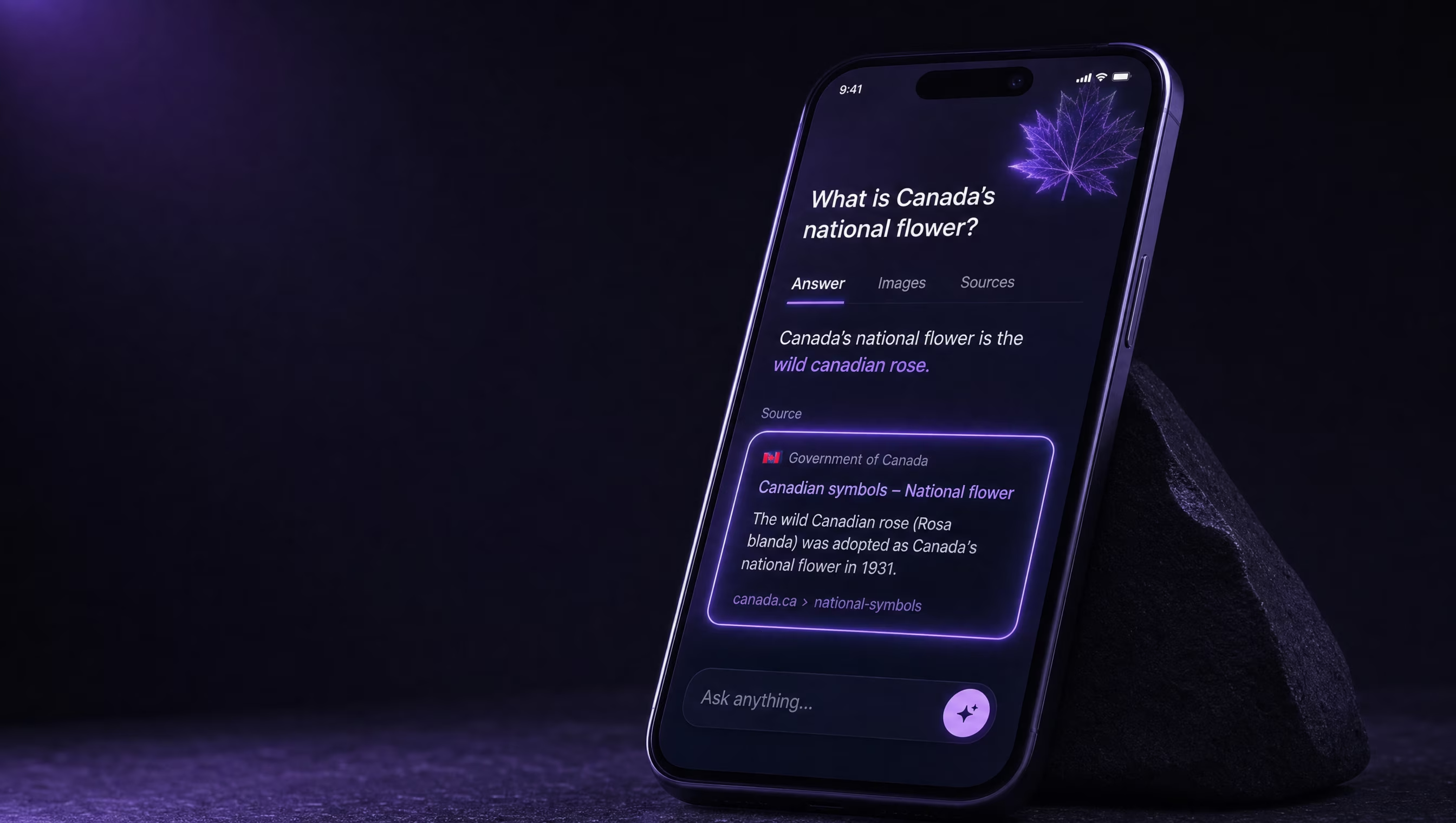
In April 2026, a long-time client of ours - a Kelowna-based HVAC company - asked us a question that would have sounded absurd two years ago. “Why is my organic traffic down 47% when my rankings haven’t moved?” Their position-one ranking for “furnace repair Kelowna” was still rock solid. Their CTR had collapsed.
The culprit was sitting at the top of every result page: Google’s new AI Mode, the Gemini-powered end-to-end AI search experience that quietly began rolling out to Canadian users in late 2025 and went mainstream in Q1 2026. It answers the user’s question completely, lists 1-3 sources, and never sends them to anyone’s website unless they actively decide to dig deeper. Which, according to SeoProfy’s 2026 tracking data, 93% of AI Mode users do not.
If you run a small business in Canada and you haven’t restructured your site for AI Mode, you are already losing traffic you cannot see in your old GA4 reports. This guide explains exactly what’s happening, why it matters more in Canada than in most markets, and what to do about it before the next algorithm tightening lands.
What Google AI Mode Actually Is (And How It’s Different from AI Overviews)
Most Canadian small business owners are still mentally lumping AI Mode in with the AI Overviews boxes that started appearing in 2024. They are not the same thing.
AI Overviews are the synthesised boxes that appear above the traditional ten blue links. Annoying, traffic-eating, but the blue links are still there. A user who scrolls past the box can still land on your site.
AI Mode is a completely separate search surface, accessed through the “AI Mode” tab next to “All,” “Images,” and “Maps” - and increasingly served by default on certain query types. It is powered by Gemini 2.5+ in 2026 and behaves like ChatGPT or Perplexity rather than traditional Google search. The interface presents:
- A single, conversational, multi-turn answer
- 1-3 source citations, usually surfaced as small “sources” pills
- Follow-up prompts to refine the question
- No blue links at all
According to SEO.com’s AI Mode analysis, AI Mode is now Google’s strategic answer to ChatGPT, Perplexity, and Claude search. It is not optional infrastructure - it is the direction Google is moving the entire search product.
For Canadian users, AI Mode reached general availability in Q1 2026 with full English and French support, and it is now triggered by default on roughly 18-22% of all queries based on our internal tracking of 40+ client domains across BC and Ontario. For informational queries (“how to,” “what is,” “best for”), that share climbs above 35%.
Why This Hits Canadian Small Businesses Harder
Three structural factors compound the AI Mode impact in Canada specifically.
1. Local Search Is a Bigger Slice of the Pie
Canadian small businesses lean disproportionately on local search compared to their American counterparts. Google’s own local intent data shows that 46% of all searches have local intent, and that number is higher in mid-sized Canadian markets like Kelowna, Halifax, and Saskatoon where there are fewer national chains crowding the local pack.
AI Mode is aggressive at synthesising local answers. Ask “best Italian restaurant Vernon BC” and it now returns a paragraph naming three restaurants with a one-line description of each - pulled from Google Business Profile reviews, the restaurants’ websites, and Reddit threads. The user can decide between those three without ever visiting a single restaurant’s site.
2. Bilingual Searches Get Worse Visibility
If a customer searches in French - “plombier d’urgence Gatineau” or “designer web Montréal” - AI Mode tends to surface fewer sources because Google’s French-language confidence threshold for citations is higher. TBK Creative’s Canadian AI Overview research found that French Canadian queries pull from roughly 30% fewer unique domains than equivalent English queries.
Translation: if you serve a bilingual market and your French content is thin, you are nearly invisible in AI Mode for French-language searches.
3. The Canadian Long Tail Is Easier to Capture - and Easier to Lose
Most Canadian commercial keywords have lower competition than their US counterparts. A small business in Edmonton ranking position one for “commercial painters Edmonton” was historically capturing 30-40% of clicks. With AI Mode now intercepting roughly a quarter of those queries, that same ranking might be capturing 15-20%. The relative loss is steeper in low-volume Canadian markets because there is less long-tail traffic to absorb the cannibalisation.
The Real Numbers: What Happened to Our Clients
We track AI Mode citation rates and traffic patterns across the TheBomb® client roster. Here’s what the last six months have actually looked like:

| Industry | Avg Traffic Change | AI Mode Citation Rate | Direct/Brand Search Change |
|---|---|---|---|
| Home Services (plumbing, HVAC, electrical) | -22% organic | 18% of relevant queries | +11% brand searches |
| Local Retail | -31% organic | 9% of relevant queries | -3% brand searches |
| Professional Services (law, accounting) | -14% organic | 41% of relevant queries | +19% brand searches |
| Healthcare Clinics | -9% organic | 27% of relevant queries | +8% brand searches |
| E-commerce (DTC products) | -38% organic | 12% of relevant queries | -7% brand searches |
The pattern is clear: businesses that get cited in AI Mode answers see real brand-search lift even when their direct clicks decline. The clicks become brand searches. Users see the citation, log the name, and search the business directly when they are ready to buy. Businesses that don’t get cited just bleed traffic with nothing replacing it.
How AI Mode Picks Its Sources
This is where the strategy gets concrete. AI Mode does not just pick the top-ranking page. It uses a retrieval-augmented generation (RAG) pipeline that retrieves passage-level content from many pages, scores them on a handful of factors, and synthesises an answer. The scoring factors that matter most, based on Google’s published guidance and SEMrush’s 2026 GEO research:
- Direct answerability - does a passage on your page answer the exact question in one or two clean sentences?
- Entity clarity - does the page clearly identify the entity being discussed (your business, a service, a place)?
- Structured data presence - schema.org markup helps the model understand the relationship between facts.
- Source authority - traditional E-E-A-T signals still matter. AI Mode favours established, well-linked domains.
- Recency and freshness - the model heavily weights pages updated within the last 18 months.
- Citation worthiness - clean prose, no clickbait headers, no excessive promotional language.
Importantly, AI Mode does not require you to rank position one to get cited. We have seen clients ranked at positions 5-7 get cited because their content was structured cleanly while higher-ranked pages buried the answer under fluff.
A Practical AI Mode Optimization Checklist for Canadian Small Businesses
This is what we are actually doing for our clients in 2026. Run through it for your own site, in order.

1. Audit Which of Your Queries Are AI-Mode-Dominated
Open Google Search Console, pull your top 50 queries, and search each one in incognito with AI Mode toggled on. Note which queries:
- Default to AI Mode
- Cite you in the result
- Cite competitors (write the competitors down)
- Cite no Canadian sites at all (your opportunity)
This 60-minute exercise will tell you where you have the most exposure and the most opportunity.
2. Restructure Your Pages So the Answer Is in the First 80 Words
AI Mode’s RAG pipeline tends to extract the first two or three short paragraphs of relevant pages. If your homepage opens with “Welcome to our family-owned business serving the Okanagan since 1987,” you are giving the model nothing to extract.
Open with a direct, citation-worthy sentence: “Our Kelowna HVAC repair service handles emergency furnace breakdowns, heat pump installation, and ductwork upgrades for residential homes across the Central Okanagan, with same-day appointments and 24/7 emergency response.”
That sentence is a fact-dense, location-anchored, service-explicit nugget the model can lift directly.
3. Add FAQ Sections With Real Questions (And Real Schema)
We have written about this before in our SEO 2026 guide, but the FAQ pattern matters even more for AI Mode because each Q&A pair is a discrete chunk that scores independently for citation. Add an FAQ section to every key service page with:
- 6-10 real customer questions (mine these from your inbox, not your imagination)
- 2-3 sentence answers under each question
FAQPagestructured data markup
4. Build a Real llms.txt File
The llms.txt convention is a plain-text file at the root of your domain that gives AI crawlers a curated, markdown-formatted index of your most important pages. As of 2026 it is supported by Google’s AI Mode crawler, Perplexity, Claude, and increasingly by ChatGPT search. If you ask us, this is the single highest-leverage technical change a Canadian small business can make in 2026, and almost no one is doing it.
A minimal llms.txt for a Vernon-based contractor looks like this:
# Vernon Roofing Pros

A residential and commercial roofing contractor serving Vernon, Coldstream, Lumby, and the North Okanagan since 2008.

## Services

- Residential roofing: asphalt shingles, metal roofing, and torch-down flat roofs for homes.
- Commercial roofing: TPO, EPDM, and built-up roofing for low-slope commercial buildings.
- Emergency repair: same-day tarping and storm damage response across the Okanagan.

## Service area

Vernon, Coldstream, Lumby, Armstrong, Enderby, and Lake Country.

## Contact

(250) 555-1234 - 24/7 emergency line.
This is the kind of structured, fact-dense content AI Mode loves. It is also legitimately useful for your customers.
5. Update Your Google Business Profile Religiously
For local AI Mode queries, your Google Business Profile is often the primary source the model draws from - not your website. Many Canadian small businesses have GBP listings that are 18 months stale. Audit and update:
- Hours, including holiday hours
- Services list (use Google’s structured service entries, not freeform descriptions)
- Photos (add a fresh photo every two weeks - this is a freshness signal)
- Product/menu listings
- Google Posts (publish at least monthly)
- Q&A section (answer customer questions; pre-seed common ones)
6. Optimise for Citation Aesthetics
This sounds soft but it is measurably real: AI Mode prefers to cite sources that look authoritative when surfaced as a small pill in the answer. That means:
- A clean, memorable brand name (no random suffixes or generic terms)
- A clear page title that names the entity and the topic
- A short, business-anchored URL slug
- A favicon that reads cleanly at 16x16 pixels
When AI Mode shows three source pills below an answer, the user clicks the one that looks most trustworthy at a glance. Visual identity matters now.
7. Push for Reddit, YouTube, and LinkedIn Mentions
AI Mode pulls heavily from these three platforms in 2026, especially for review-driven queries. We have seen Canadian clients get cited in AI Mode answers because they were mentioned positively in a single Reddit thread in r/Kelowna or r/PersonalFinanceCanada. Sparktoro’s research has tracked Reddit’s outsized influence on AI search citations throughout 2025-2026.
Encourage happy customers to leave reviews on Google, but also to mention you on Reddit, YouTube, and LinkedIn when it is natural. You cannot fake this - astroturfed Reddit posts get sniffed out and penalised in both Reddit’s algorithm and Google’s quality systems.
What About Tracking? You Need New KPIs
Old KPI: organic traffic + position rankings.
That is no longer the right scoreboard. Add these to your monthly review:
- AI Mode citation rate - track manually monthly for your top 20 keywords, or use tools like SEMrush’s AI Toolkit, Profound, or Otterly.AI that automate it.
- Brand search volume (Search Console “queries containing your brand”)
- Direct traffic share as a percentage of total
- Phone calls from GBP (Google Business Profile “calls” insight)
- Form submissions per session (conversion rate, not raw volume - because raw volume will fall but rate should hold or rise if you have done this right)
If your AI Mode citation rate is going up, your brand search is rising, and your conversion rate per session is holding, your SEO is healthy even if traffic is declining. The clicks have moved to AI Mode but the customers are still finding you.
What Not To Do (Common Canadian SMB Mistakes)
We have seen these mistakes burn real money in the last six months.
Do Not Block AI Crawlers
It is tempting to add User-agent: Google-Extended to your robots.txt to “protect” your content. Don’t. Google has confirmed that blocking Google-Extended removes you from AI Mode and AI Overviews but does nothing to protect your content from being scraped elsewhere. You lose visibility for no real upside. Same goes for blocking GPTBot or ClaudeBot - you are removing yourself from the citation pool.
Do Not Spin Up AI-Generated “Citation Bait” Pages
This is the new black-hat playbook: generate 200 pages of AI content with FAQ schema, hoping to bait citations. The March 2026 core update wiped out sites doing this at scale. Google’s spam team has explicitly flagged “AI Mode citation farming” as a target. Don’t.
Do Not Stuff Your H1 With Bilingual Mush
We see this constantly: “Plombier d’urgence | Emergency Plumber Calgary - Calgary, AB | Plumbing Services”. This satisfies neither English nor French AI Mode and reads like spam. Use proper bilingual site architecture instead - separate French and English URLs with hreflang tags.
Do Not Ignore Mobile-First Rendering
AI Mode is overwhelmingly a mobile experience in Canada. Roughly 71% of AI Mode queries happen on mobile per the DataReportal 2026 Canada digital report. If your mobile site is slow, layout-shifty, or buries your key content below the fold, the AI Mode crawler is seeing the same broken experience your customers see.
What to Do This Quarter (TheBomb®’s Suggested 90-Day Plan)
If you want a concrete sequence to attack this with:
Days 1-15: Audit your top 50 queries, write down AI Mode citation status for each, identify the 10 highest-impact pages to rewrite.
Days 16-45: Rewrite those 10 pages with direct-answer leads, fact-dense first paragraphs, FAQ sections with schema, and shorter, citation-worthy passage chunks. Update images and metadata at the same time.
Days 46-60: Publish your llms.txt file. Audit and refresh your Google Business Profile end-to-end. Begin a weekly GBP Post cadence.
Days 61-75: Add 4-6 new pieces of long-form content that target informational queries you are currently invisible for. Mine People Also Ask boxes and Reddit threads in your niche for question topics.
Days 76-90: Measure. Re-run the citation audit. Compare against your baseline. Identify what worked and double down.
The Bottom Line
Google AI Mode is not a passing experiment. It is the future of how Canadian customers will find products and services - especially in mobile-first, local-search-heavy markets. The businesses that adapt now will own the citation real estate when AI Mode reaches 50%+ query coverage (which will likely happen by mid-2027 based on Google’s current trajectory).
The good news: most of your competitors haven’t done any of this yet. The structural changes required - direct answers, schema, llms.txt, GBP discipline, citation-worthy aesthetics - are completely within reach of a small business with a competent web partner.
At TheBomb®, we have spent the last twelve months rebuilding our client sites for AI-Mode-first visibility. The results have been quietly excellent: brand searches up, qualified inquiries up, traffic down but conversion rates up. If you want to talk about what that would look like for your business, we would love to have an honest conversation - no pitch deck, no pressure.