
Yes - for almost every small business in 2026, you still need a website, even if you already have an Instagram account and a Google Business Profile. A website is the one piece of your online presence that you actually own, that you fully control, and that quietly does the heavy lifting of turning a curious stranger into a paying customer. Social media and your Google profile are powerful, but they are platforms you rent, not assets you own - and that difference matters more than most owners realise until something goes wrong.
Let’s be honest about it, because this is a question worth asking. You are busy running a business, money is tight, and the internet is full of people who will happily charge you for things you do not need. So the real question is not “should I have a website because everyone says so” - it is “does a website actually do something useful for my business, or is it a vanity expense?” Here is the straight answer for Canadian small-business owners.
Does a Small Business Need a Website in 2026?
A small business needs a website in 2026 because a website is your conversion hub, your credibility check, and the foundation that feeds everything else - including your Google profile and the new wave of AI search. Social media gets you attention. A Google Business Profile gets you found locally. But a website is where attention turns into action: someone reads, trusts, and then calls, books, or buys.
Think about how people actually behave. They hear about you - from a friend, an ad, a post, a sign on a truck - and the very first thing they do is look you up. According to BrightLocal’s ongoing consumer research, the overwhelming majority of people read online information about a local business before deciding to use it. When they search and there is no website (or a broken, abandoned one), a quiet little doubt creeps in. Are these people still in business? Are they legit? Should I just call the competitor who does have a proper site?
You never see that doubt. It costs you customers you will never know you lost.
You own a website. You rent everything else.
This is the part nobody wants to hear, but it is the most important reason of all. Your Instagram, Facebook, TikTok, and Google profile are not yours. You are a tenant on someone else’s platform, and the landlord can change the rules - or evict you - at any time.
Accounts get locked over a misunderstood automated flag. Reach gets throttled because the algorithm changed overnight. A platform shifts its priorities and the audience you spent years building suddenly sees a fraction of your posts. It happens to good, honest businesses constantly, through no fault of their own, and the appeals process is a black box.
Your website does not do any of that. It sits on a domain you own, with content you control, and it answers to you. When you build an email list through it, that list is yours forever. A website is the only piece of your digital presence that cannot be taken away by an algorithm change or a suspended account. For a small business, that stability is not a luxury - it is insurance.
Do I Need a Website If I Have Social Media?
You still need a website even if you have a strong social media presence, because the two do different jobs. Social media is how people discover you and stay engaged. A website is how people evaluate you and decide to act. One feeds the funnel; the other closes it.
Social platforms are built to keep people on the platform, not to send them to your business. They are noisy, designed for scrolling, and terrible at presenting your full offer, your pricing, your service area, your hours, and your booking form in one calm, searchable place. Try explaining your three service packages and your warranty in an Instagram bio. You cannot. A website gives you room to actually make your case.
There is also the matter of being found at all. Most people do not find a plumber or a bookkeeper by scrolling social media - they search Google. A website is what shows up there. If you want to compete for searches like “web designer near me” or “accountant in Kelowna,” you need pages that search engines can read and rank, and that is your site, not your feed. We dig into how that works for BC businesses in our guide to local SEO in British Columbia.
The best setup is not website or social - it is both, working together. Social earns attention and points it somewhere; your website catches that attention and converts it.
Website vs Social Media vs Google Business Profile: An Honest Comparison
So how do these three stack up against each other? Here is a fair, side-by-side look at what each one actually does well - and where it falls short.
| What matters | Your website | Social media only | Google Business Profile only |
|---|---|---|---|
| Ownership and control | You own it fully | Rented - rules and reach change | Rented - Google controls it |
| Risk of being shut off | Very low | High (suspensions, throttling) | Medium (suspensions happen) |
| Found in Google search | Strong - rankable pages | Weak for search intent | Good for local “near me” |
| Room to explain your offer | Unlimited | Very limited | Limited fields only |
| Credibility check | High - your home base | Mixed | Decent, but thin |
| Conversion (call, book, buy) | Built for it | Clunky | Basic actions only |
| Longevity of your content | Permanent | Buried within days | Limited and shallow |
| Feeds the others | Yes - anchors everything | No | No |
Notice the pattern. Social media and a Google profile are genuinely valuable, and you should use both. But each one has a ceiling, and that ceiling is “control, depth, and conversion.” Your website is the only option that scores well across every row - and crucially, it is the only one that makes the other two work better.
Why Is a Website Important for a Small Business?
A website is important for a small business because it does five jobs at once, and no other single tool covers all of them: it builds credibility, it gets you found, it converts visitors into customers, it gives you an asset you own, and it feeds the AI and local search systems that increasingly decide who gets recommended.
It is your credibility check
People Google you before they buy from you - always. Your website is the moment they decide whether you look like a real, trustworthy business or a fly-by-night operation. A clean, fast, professional site says “these people are serious.” A missing or outdated one plants doubt. For a small business competing against bigger names, looking credible is often the whole game.
It is your conversion hub
This is the job social and Google profiles do poorly. Your website is where you put the click-to-call button, the booking form, the clear offer, the answers to the questions that stop people from buying. Everything you do online can point here, to one place that is designed to turn interest into action. If you want to understand how that funnel works end to end, our piece on Canadian small-business lead generation walks through it.
It feeds your Google profile and AI search
Here is what changed recently and why this matters more than ever. Google and AI assistants now pull information from across the web to decide who to surface and recommend. Your Google Business Profile, AI Overviews in search, and tools like ChatGPT all lean on consistent, authoritative information - and your website is the canonical source they trust most. Google Search Central has long emphasised that a well-structured site helps search systems understand your business. No website means no anchor for any of it. You are asking the machines to recommend you while giving them nothing solid to read.
It works while you sleep
A good website answers questions, takes bookings, and qualifies leads at 2 a.m. on a Sunday. That is leverage a small team cannot buy any other way.
When Can a Small Business Wait on a Website?
Honesty cuts both ways, so here are the few real cases where a full website can wait - and why even these businesses usually benefit from at least a simple one.
You are validating a pre-launch idea. If you have not confirmed people will pay for your thing yet, do not sink weeks into a big site. Test the offer first with a landing page, a few conversations, or a market stall. But - even idea validation goes faster with a single, simple page that explains the offer and captures emails. It is cheap, and it gives you something to point people to.
You are purely referral-based with a full calendar. Some tradespeople and consultants are booked solid for months on word of mouth alone. If that is genuinely you, a website is not urgent today. But think about the day a major referral source retires, moves, or dries up. The businesses that get caught flat-footed are the ones that never built an asset of their own while times were good. A simple, credible site is cheap insurance against a slow season you cannot yet see coming.
In short: the cases where you can wait are real, but they are fewer than people hope, and they almost always still benefit from a lightweight site. “I can wait” is rarely the same as “I should never bother.”
What Does a Small-Business Website Actually Need in 2026?
You do not need a giant, expensive site. You need a focused one that does its job. Here is the short list of what genuinely matters now.
- Fast and mobile-first. Most of your visitors are on a phone, and they leave if it is slow. A site that loads in under two seconds and reads cleanly on mobile is non-negotiable.
- A clear offer above the fold. Within five seconds, a visitor should know what you do, where you do it, and what to do next. Confused visitors leave.
- Click-to-call and easy booking. On mobile, a tap-to-call button and a simple contact or booking form remove all the friction between interest and action.
- Local SEO basics. Your service area, location, and the services you offer, written in plain language so both people and search engines understand you.
- Trust signals. Real reviews, a real address or service area, and a professional look. (For what it is worth, we hold a 5.0 rating from 20 Google reviews, and that kind of social proof on your own site reassures buyers.)
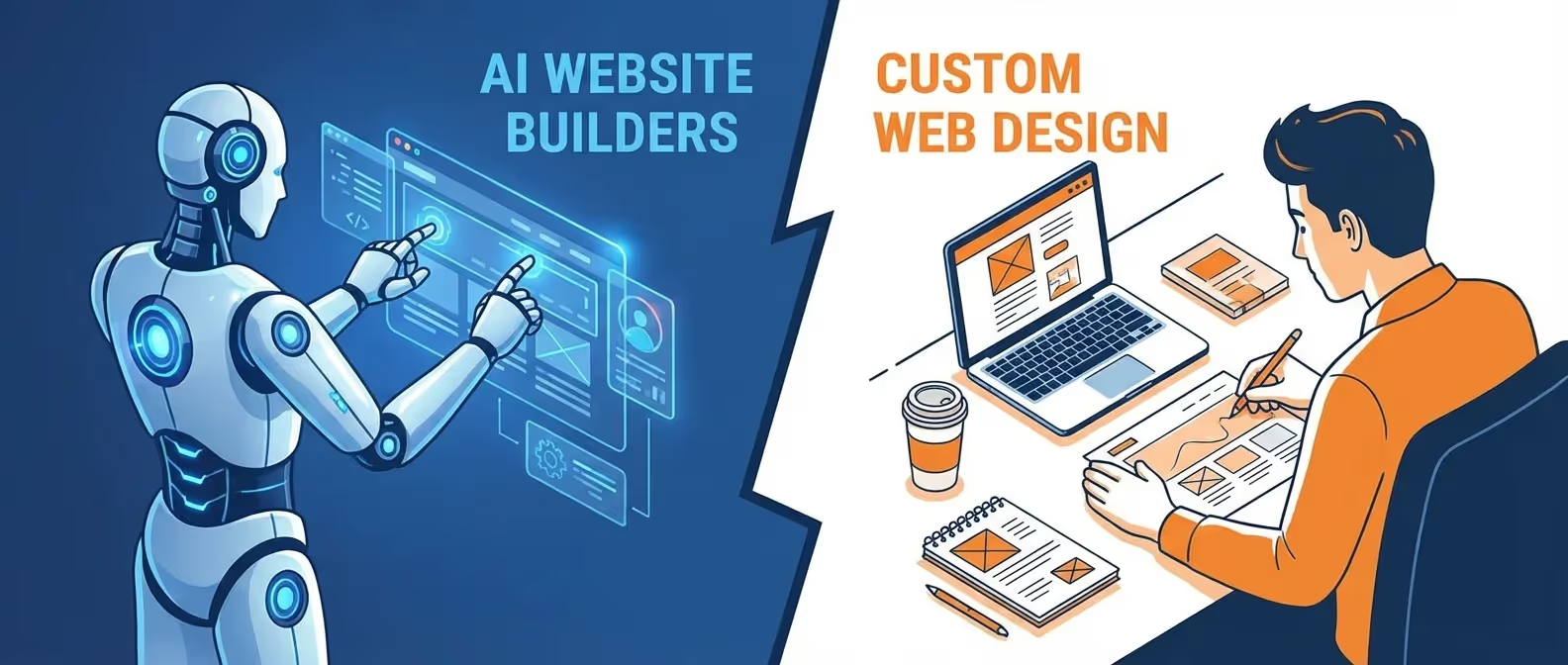
That is the core. You can build this yourself on a website builder or hire it out - both are valid, and the right choice depends on your goals and budget. We compare the trade-offs honestly in custom web design vs Wix and Squarespace, and we break down real numbers in how much a website costs in Canada. The point is not to gold-plate it. The point is to have one that works.
The Honest Bottom Line for Canadian Owners
If you run a small business in Canada in 2026 and you sell to local customers, you need a website. Not because it is trendy, and not because an agency told you to - but because it is the one online asset you own, the place where trust is won and sales are closed, and the foundation that makes your Google profile, your ads, your social media, and even AI search actually pay off. Social media and a Google listing are the front door and the welcome mat. Your website is the house.
The good news is that getting a proper, focused site is more affordable and faster than the horror stories suggest. You do not need to spend a fortune. You need something fast, clear, and built to convert - and then you let everything else point to it.
If you have been putting this off, or you have a site that is slow, dated, or not bringing in leads, that is exactly what we fix. Have a look at our web design services to see how we approach it, then get in touch and tell us about your business. We are a small studio in the North Okanagan working with clients across BC and Canada, and we will give you an honest answer about what you actually need - even if that answer is “less than you think.”
Frequently Asked Questions
Does a small business need a website in 2026?
Yes. For almost every small business that sells to customers, a website is still essential in 2026. It is the one online asset you fully own and control, it is where searchers decide whether to trust you, and it is the hub that turns attention from social media and your Google profile into actual calls, bookings, and sales. The rare exceptions - pre-launch idea validation or a fully booked referral-only operation - usually still benefit from at least a simple page.
Do I need a website if I have social media?
Yes, because social media and a website do different jobs. Social media is built to grab attention and keep people on the platform, while a website is built to explain your full offer, get found in Google search, and convert visitors into customers. You also own your website outright, whereas a social account can be throttled or suspended at any time. The strongest setup uses both: social earns attention, and your website closes the deal.
Why is a website important for a small business?
A website is important because it builds credibility (people Google you before buying), gets you found in search, converts interest into action, gives you an asset no algorithm can take away, and feeds the Google and AI systems that decide who gets recommended. No other single tool does all five of those jobs. For a small business competing against bigger names, that combination is often the difference between being chosen and being skipped.
Is a Google Business Profile enough without a website?
A Google Business Profile is essential for local visibility, but it is usually not enough on its own. It is great for showing up in “near me” searches and on Google Maps, but it offers limited room to explain your offer, it is controlled by Google rather than you, and it cannot do the deeper conversion work a website does. It also performs best when it links to and is reinforced by a real website - the two work far better together than either does alone.
Key Takeaways
- For almost every Canadian small business in 2026, a website is still essential - even with social media and a Google profile.
- You own your website; you only rent social media and your Google listing, and those can be throttled or suspended without warning.
- A website does five jobs at once: credibility, getting found, conversion, owned asset, and feeding AI and local search.
- Social media earns attention and a Google profile gets you found locally - but your website is where that attention turns into customers.
- A Google Business Profile is necessary but rarely sufficient; it works best linked to and reinforced by a real website.
- The few cases where a site can wait (idea validation, fully booked referral work) still usually benefit from a simple page.
- A modern small-business site does not need to be expensive - just fast, mobile-first, clear, and built to convert.