
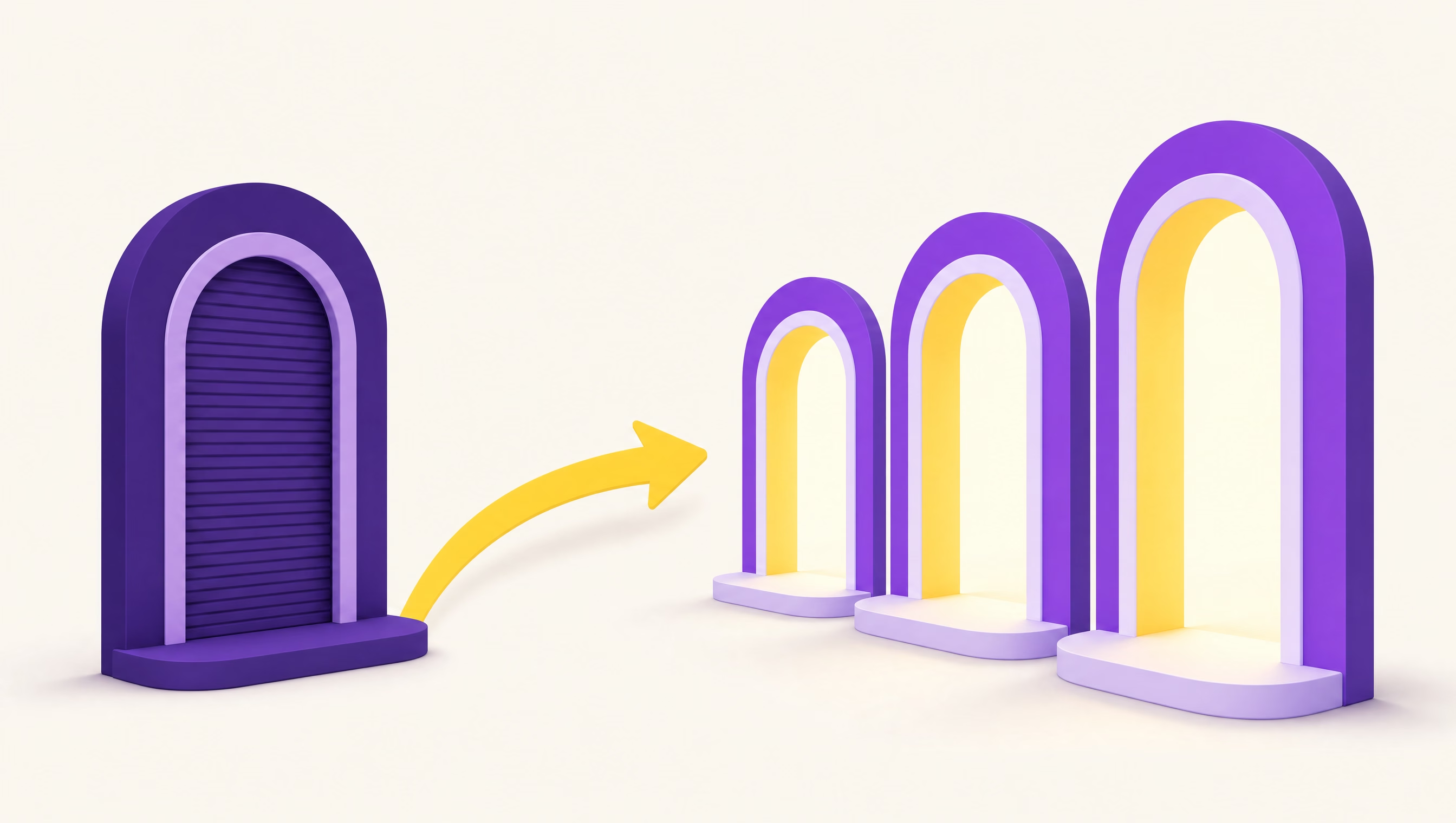
OpenAI listed September 24, 2026 as the shutdown date for the Sora 2 models and Videos API. That date has passed. Its official deprecation notice lists no recommended replacement for those entries. If your application still calls them, review and replace those integrations now.
The Sora web and app experiences were discontinued on April 26, 2026. The API notice covers sora-2, sora-2-pro and the dated snapshots listed below.
There is no named replacement in that notice, so migration means choosing a different workflow and validating it against your own outputs. Quality and cost depend on the provider, settings and number of attempts needed to produce a usable clip.
Some links below are affiliate links. We earn a commission at no cost to you.
What the Official Shutdown Notice Covers
| Item | Date |
|---|---|
| Deprecation notice issued | March 24, 2026 |
| Sora web and app discontinued | April 26, 2026 |
| Listed shutdown date for Videos API and Sora 2 models | September 24, 2026 |
The listed models are sora-2, sora-2-pro, and the dated snapshots sora-2-2025-10-06, sora-2-2025-12-08 and sora-2-pro-2025-10-06. The notice also lists the Videos API itself.
For integrations that missed the deadline, start with failed jobs and remaining call sites. For saved videos, check your own storage first. Consumer-app export options and API asset availability are separate matters; do not assume an API download remains available after its shutdown date.
The Short Answer
Choose a replacement by testing the clips your business actually needs. Compare motion, character consistency, dialogue, reference-image support, commercial terms and the total cost of getting an approved output. A multi-model platform can make that comparison easier.
Check current provider pricing rather than comparing a single advertised per-second rate. Resolution, duration, audio, retries and subscription credits can all change the effective cost. A 4K export also does not necessarily mean the model generated the clip at native 4K.
Match Your Use Case to a Replacement
You used Sora for product or character shots. Compare the reference-image workflows available in your chosen platform, including Seedance and Kling options where offered. Test the same brief and brand references across models; a general leaderboard does not establish which one will preserve your product best.
You used Sora for clips with speech. Google’s video-generation documentation describes Veo 3.1’s native audio and Gemini Omni Flash’s video-generation and editing workflows. Compare dialogue intelligibility, lip sync and scene continuity using your script, rather than assuming a model is a drop-in replacement.
You used Sora for cinematic sequences at volume. Check camera control, clip length, editing options and generation limits. Measure the cost per accepted clip, including retries and any upscaling or editing, before committing to a subscription.
You need self-hosting. Check the specific model’s official release, licence and hardware requirements. An open-weight option still carries infrastructure, maintenance and generation costs, and its terms may differ from a hosted service using the same model family.
You do not want to choose again in six months. This is the honest lesson of the whole episode, so it gets its own section.
The Real Lesson: Stop Betting on One Model
The shutdown is a useful reminder that an external model endpoint can be retired. Anyone whose product depends on one needs a migration plan, saved assets and a way to evaluate alternatives.
Models, prices and access terms change. Keep your brand references and generation briefs portable, and avoid assuming that switching providers preserves the same prompts, output quality or usage rights.
One option is an aggregator. Higgsfield is the platform we use for client visual production. It brings multiple image and video workflows into one account. Check the current catalogue and your plan’s access before choosing it for a particular model or API integration.
That can reduce account and billing overhead. It does not remove migration work: models can require different inputs, and their API parameters, duration limits and outputs still need validation.
Keep provider deprecation notices on your maintenance checklist even when you use an aggregator.
Migration Checklist
If an application or scheduled workflow still depends on Sora, work through this now.
- Find every call site. Search your codebase for the Videos API endpoint and any
sora-2model string, including the dated snapshots. Check scheduled jobs and internal tools, not just the main application. - Pick a replacement per use case, not one for everything. Dialogue and cinematic B-roll want different models now.
- Regenerate your reference outputs. Prompts do not transfer cleanly between models. Budget time to re-tune the ten or twenty prompts you actually rely on.
- Check your saved assets. Locate videos already downloaded to your own storage. For consumer-app content, follow OpenAI’s current export instructions; do not promise recovery of assets that are no longer accessible.
- Re-check your costs. Compare billing for the actual settings and retries needed to deliver usable clips. A lower headline rate may not produce a lower project cost.
- Separate provider-specific calls from your workflow. Keep brand references, prompts and output records portable, and test a replacement before routing production jobs to it.
What This Means If You Are Not a Developer
Most people reading this never touched the Sora API. The consequence for you is simpler: the tool everyone recommended in 2025 is gone, and the recommendations you saved are stale.
If you are a small business making short-form video, start with one real brief and a small trial budget. Check whether the service produces usable footage, supports your brand references and permits your intended commercial use. Our AI content generators guide introduces the wider field, and our Higgsfield review explains the aggregator workflow we use.
Your prompts, brand references, process and archived output remain useful when tools change. Keeping them portable gives you a better starting point for the next migration, even when the integration needs substantial work.
Frequently Asked Questions
Is Sora coming back? The Sora entries in OpenAI’s deprecation notice list no recommended replacement. Check official OpenAI announcements for any later product changes.
What happens to videos I already generated? The listed API shutdown date has passed. Check your own downloaded assets and backups. OpenAI’s help article gives export instructions for consumer-app content, but that does not guarantee access to API-hosted videos.
What is the closest replacement to Sora 2? There is no universal replacement. Test the current models available to you against your actual motion, dialogue and brand-reference requirements, and expect to adjust prompts and integrations.
Is there a cheaper option than Sora was? Possibly. Compare current pricing for equivalent resolution, duration and audio, then include retries and editing in the cost per accepted clip. Do not assume that every alternative is cheaper.
Do I have to pick just one? No. Aggregators like Higgsfield offer multiple workflows in one account. Confirm your plan’s catalogue and usage terms, and test each workflow before relying on it.
TheBomb® is a web design and SEO studio founded in 2014 in Spallumcheen, BC, building fast, friendly websites for businesses across Canada and the US. We use these tools daily for client visual production. Get in touch if you need a site to put it all on.